
The real power of play-based learning comes from its ability to tap into a child's natural curiosity. It's an approach that builds crucial academic, social, and emotional skills through what we call purposeful play. Instead of passively absorbing information, kids become active, joyful explorers in their own learning journey.
So, What Is Play Based Learning Really?
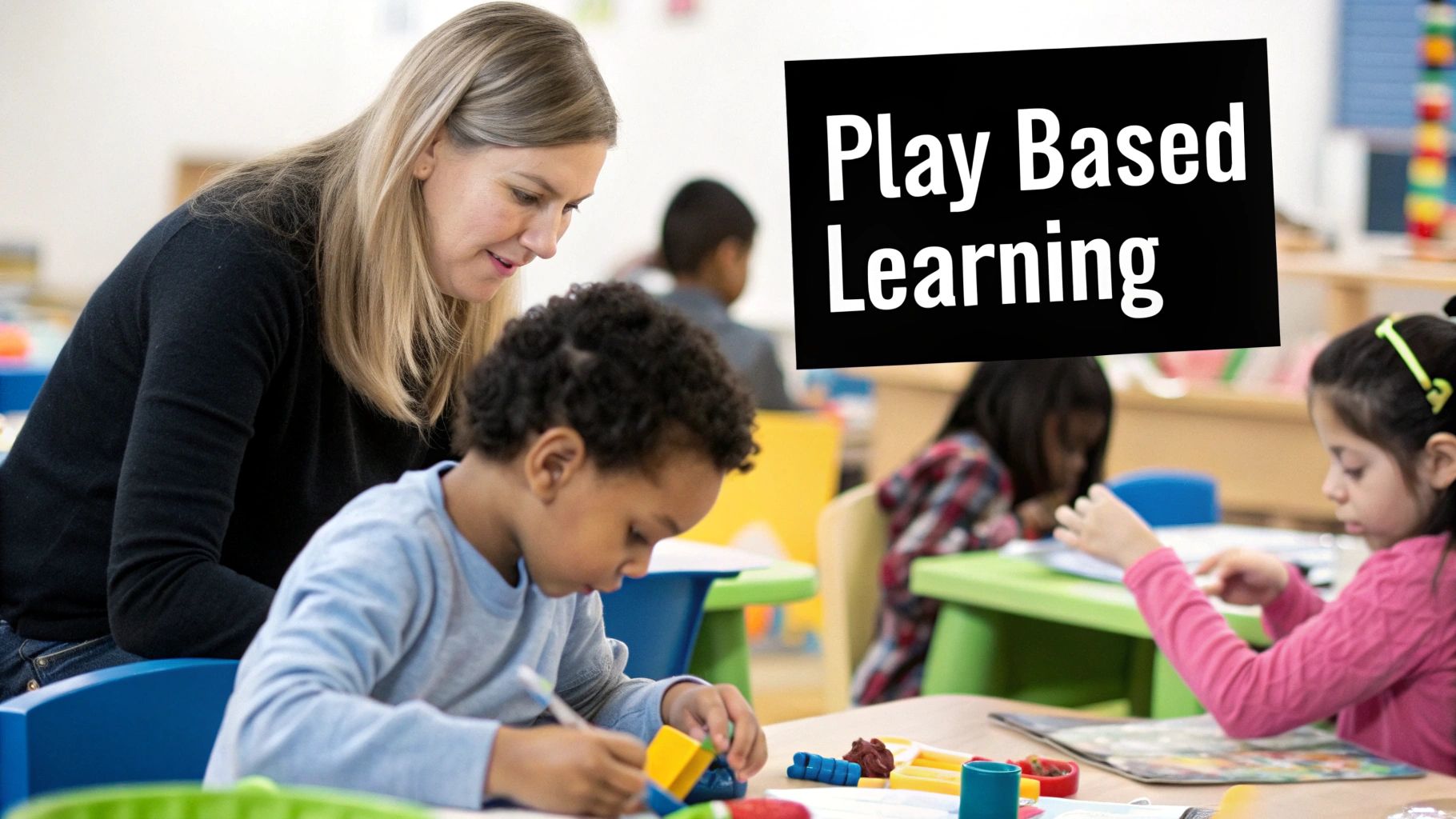
Picture a classroom filled with silent, repetitive drills. Now, imagine one buzzing with creative energy and collaborative chatter. That's the difference play-based learning makes. It's a philosophy where children learn about themselves and the world around them through hands-on investigation and discovery.
This isn’t just letting kids run wild. It's a thoughtfully crafted environment where teachers act as guides, not lecturers. They intentionally set up activities and spaces that invite children to explore concepts, tackle problems, and work together.
The educator’s role shifts from being a "sage on the stage" to a "guide on the side," supporting the learning process instead of dictating it. This model honors the child as an active participant, not just an empty vessel waiting to be filled with facts.
To see the breadth of benefits at a glance, this table breaks down how play supports a child's complete development.
Key Play Based Learning Benefits at a Glance
| Developmental Area | Core Benefits and Skills |
|---|---|
| Cognitive | Boosts problem-solving, critical thinking, creativity, and executive function. |
| Social | Encourages collaboration, negotiation, sharing, and understanding social cues. |
| Emotional | Helps children manage feelings, build empathy, develop self-regulation, and resilience. |
| Physical | Refines fine and gross motor skills, coordination, and spatial awareness. |
| Language | Expands vocabulary, communication skills, and storytelling abilities through interaction. |
Each area is interconnected, with skills learned in one domain often reinforcing growth in another.
Intentional Play Versus Unstructured Play
A common myth is that a play-based approach isn't academically serious. Nothing could be further from the truth. The magic is in the intentionality. While free, unstructured play is absolutely essential, guided play is where educators masterfully weave learning goals into activities kids already love.
A water table, for instance, isn't just for splashing around. It's a mini-science lab for exploring buoyancy and volume. A block corner becomes a budding engineering firm where children experiment with balance, symmetry, and structural integrity.
What makes this learning style so effective? It all comes down to a few key ingredients:
- Child-Initiated Exploration: Kids get to choose activities based on what genuinely interests them, which naturally leads to deeper focus and motivation.
- Teacher-Supported Discovery: Educators pose open-ended questions like, "What do you think will happen if...?" to spark critical thinking, rather than just giving away the answers.
- Process-Oriented Focus: The real learning is in the journey—the experimenting, the "oops" moments, and the problem-solving—not just in producing a perfect end result.
- Imaginative Engagement: Pretend play is treated as serious work. It’s where children develop empathy, practice complex social skills, and build their vocabulary.
Setting the Stage for Lifelong Learning
Ultimately, this philosophy cultivates a positive, can-do attitude toward education itself. When learning is fun and driven by curiosity, children develop a genuine love for asking questions and finding answers.
They learn how to learn, which is the most critical skill for all future success in school and in life. To dive deeper, this guide on how children learn through play offers fantastic insights for parents. This approach doesn't see play as a break from learning; it understands that for a child, play is learning.
How Play Builds a Smarter Brain
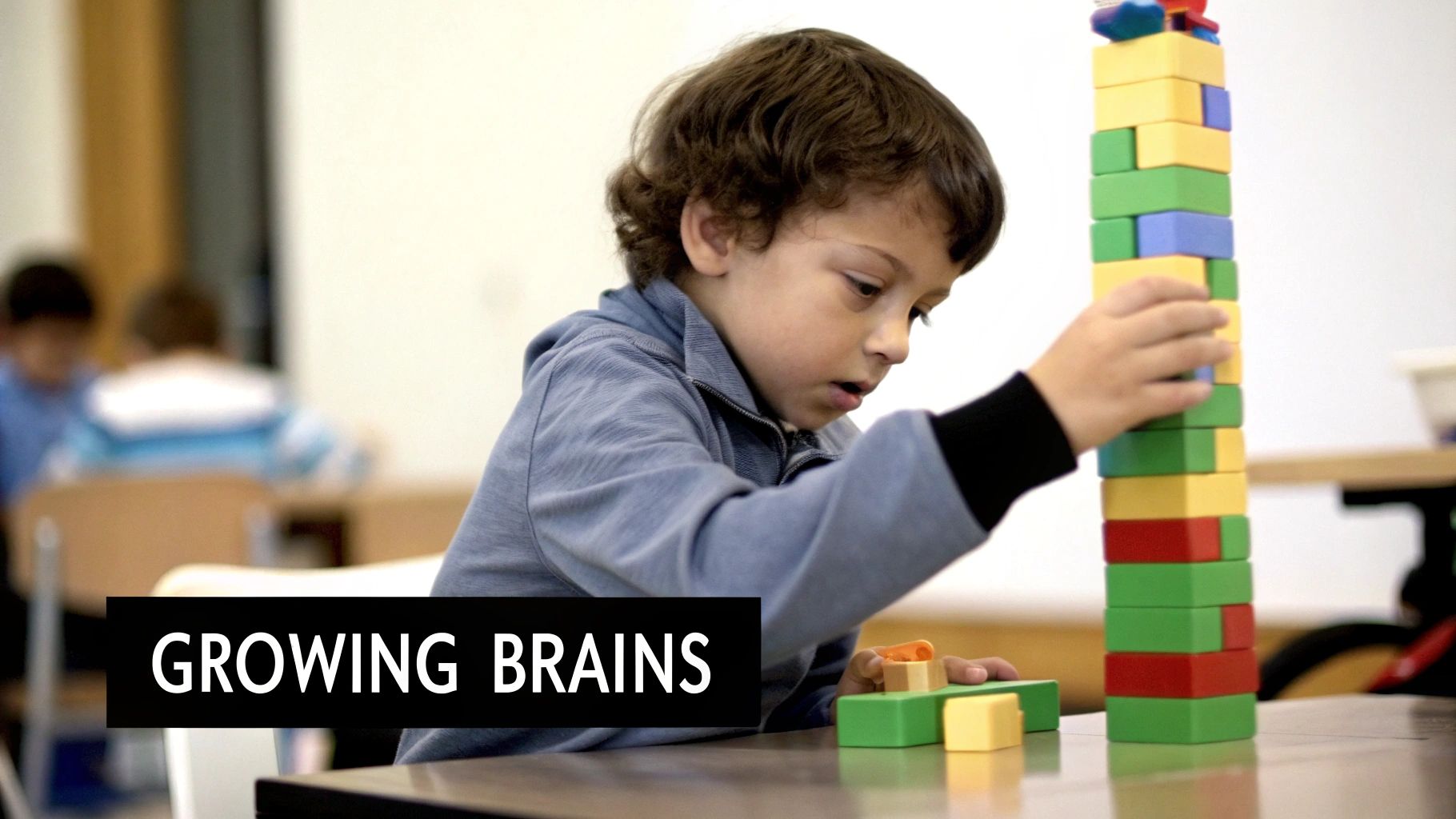
To really get why play-based learning is so powerful, we need to peek inside a developing brain. Picture a child's mind as a brand-new city under construction. Every time they play, it's like a crew of master builders shows up, laying down essential roads and wiring up the power grid.
When a child is deep in concentration stacking blocks, figuring out a puzzle, or making up a story with a friend, they're doing more than just having fun. They are physically building and strengthening neural pathways—the superhighways that carry information throughout the brain. The more a child uses these pathways, the stronger and faster they get, creating a solid foundation for everything they'll learn later in life.
This process is especially vital for what we call executive functions, which are basically the brain’s air traffic control system. These are the skills that let us plan, stay focused, remember rules, and juggle different tasks. Play is, without a doubt, the most important training ground for these core life skills.
Fostering Critical Thinking and Problem-Solving
Think about a group of kids determined to build the ultimate pillow-and-blanket fort. When it inevitably tumbles down, they don’t just give up. They see a puzzle to solve. This isn't just a game; it's a hands-on lesson in engineering, physics, and teamwork.
They start asking questions, trying out new theories, and tweaking their designs. "What if we use the big cushion for the bottom?" one might suggest. This is problem-solving at its purest, fueled entirely by their own curiosity and shared goal.
Play gives children a safe space to experiment without the fear of failure. It teaches them that trial and error is just a normal, even necessary, part of getting things right. This builds incredible resilience and a "can-do" attitude from a very young age.
This kind of mental workout strengthens a child's ability to think critically and face new challenges with confidence instead of anxiety.
Enhancing Mental Flexibility and Adaptability
The world of make-believe is anything but predictable. The rules of a game can change on a whim. A cardboard box transforms from a race car into a rocket ship in a matter of seconds. This constant change demands a huge amount of cognitive flexibility.
This is the brain's ability to pivot—to adjust to new information, see things from another perspective, and change course when needed. Just look at how play builds this mental agility:
- Role-Playing: When kids pretend to be doctors, chefs, or superheroes, they have to constantly adapt their language and actions to fit the part.
- Negotiating Rules: Simply deciding how a game will work forces children to listen to different ideas and find a compromise, shifting their own thinking to match the group's.
- Open-Ended Toys: A simple pile of wooden blocks has endless possibilities. It could become a tall skyscraper, a long bridge, or a cozy home, encouraging kids to see potential in everything.
These everyday play scenarios are training the brain to be nimble and adaptable, a skill that's absolutely essential for navigating a complex and ever-changing world.
Cultivating Self-Control and Regulation
Guided play is also packed with opportunities for kids to practice self-control. Waiting your turn for the slide, sharing that one toy everyone wants, or following the group's plan for a LEGO creation all require patience and impulse control.
When a child successfully manages their frustration after their block tower comes crashing down, they are strengthening the brain circuits responsible for emotional regulation. Adults can support this by naming the feeling ("It's so frustrating when that happens, isn't it?") and then encouraging another try. This is even more crucial for some, as research on children with ADHD needing more play shows how it can be a game-changer for their focus and self-management skills.
At the end of the day, play isn't just a break from learning—it is the learning. It's the most natural and effective way for children to construct a brain that is resilient, adaptable, and sharp, proving that fun and games are the true engine of cognitive growth.
Connecting Play to Academic Success
One of the most persistent myths about play-based learning is that it comes at the expense of academics. We often picture a tug-of-war between playful exploration and "real" learning, but this is a false choice. In reality, guided play is one of the most powerful and natural ways to build the very foundation needed for long-term academic achievement.
Think of it like this: you can teach a child the definition of "gravity" from a book, and they might memorize it. But when that same child experiences gravity firsthand by figuring out why their block tower keeps toppling over, the lesson becomes real, intuitive, and unforgettable. Play provides the context that makes abstract concepts click.
Building Future Readers and Writers Through Storytelling
Literacy is so much more than just recognizing letters on a page. At its heart, it’s about understanding stories, building a rich vocabulary, and learning how to communicate. A simple puppet show or an elaborate game of make-believe is a masterclass in all three.
When children invent characters and act out elaborate plots, they're not just playing; they're experimenting with new words, practicing dialogue, and absorbing the natural rhythm of storytelling—a beginning, a middle, and an end. A simple question from an educator, like, "Oh no! What does the brave knight do next?" prompts them to think sequentially, a critical pre-reading skill.
This is how vocabulary truly sticks. Hearing the word "enormous" used to describe a pretend dragon they just battled is far more meaningful than seeing it on a flashcard. The emotion and action of the story cement the word in a child’s mind.
Discovering Math and Science in Everyday Play
That messy block corner in a preschool classroom? It's actually a bustling laboratory for physics and engineering. As children build, they are constantly running experiments without even knowing it, discovering core principles of balance, symmetry, geometry, and spatial awareness through pure trial and error.
A child carefully stacking blocks is learning about weight distribution. Two kids trying to build a bridge across a gap are solving a genuine engineering problem. These hands-on moments create a concrete understanding that serves as the bedrock for the abstract math and science concepts they'll encounter down the road.
Play also nurtures the very heart of scientific inquiry: curiosity. It teaches children to:
- Observe: "I noticed the round blocks always roll away."
- Hypothesize: "Maybe if I use the square blocks for the bottom, my tower will be stronger."
- Test: They try the new method and see what happens.
- Draw Conclusions: They learn what works and adapt their strategy for the next attempt.
This is the scientific method in its purest form, driven not by a worksheet, but by a child's own desire to make something work.
The Research Backs It Up
This connection between play and school readiness isn't just a nice idea; it's supported by a growing body of evidence. Studies consistently show that when kids have more opportunities to engage in high-quality play, their academic skills get a measurable boost. This is especially true for foundational areas like mathematics and self-regulation—a key skill for learning how to read.
A recent study that followed children from ages four to five found that every extra hour of play at home each day was linked to a significant increase in their early math abilities. The focus and self-control they developed through play also indirectly supported their emerging literacy skills.
This research highlights one of the most critical benefits of play-based learning: it doesn't force a choice between play and academics. It actually uses play as the engine that drives academic growth. For a deeper look, you can explore the full study about how play improves early math skills.
Cultivating a Lifelong Love for Learning
Perhaps the most profound academic benefit of a play-based approach is the mindset it creates. When learning feels like an adventure—joyful, engaging, and driven by curiosity—children don’t see it as a chore.
Kids who learn through play grow into confident, creative problem-solvers who aren’t afraid to take risks or make mistakes. They develop a positive attitude toward school because their first experiences were filled with discovery and fun. This intrinsic motivation is the secret to creating not just successful students, but true lifelong learners.
Where Kids Learn to Be Human: Emotional Growth on the Playground
Beyond reading and writing, some of the most profound lessons of childhood happen when kids are simply playing together. The playground, the dress-up corner, or a sprawling fort built from couch cushions aren't just for fun—they're real-world labs where children learn to be human.
These aren't just "soft skills." They're the core abilities kids need to build lasting friendships, handle life's ups and downs, and truly understand who they are. It’s in these messy, joyful, and sometimes frustrating moments of play that a resilient emotional foundation gets built, one small interaction at a time.
The Social Sandbox
Think about a few kids trying to build a castle in a sandbox. It sounds simple, but it’s a masterclass in social dynamics. One child wants a tall tower, another wants a wide moat. To get anywhere, they have to talk, listen, and figure out a plan together. This is negotiation and cooperation in its purest form.
They quickly learn that just demanding what they want doesn't work. They have to listen to each other's ideas, find a way to merge their visions, and ultimately compromise. It’s a powerful, hands-on lesson that their way isn't the only way, and that collaboration often creates something better than they could have imagined alone.
Through this simple act, they're practicing essential skills:
- Truly listening: They have to actually hear what their friends are saying to be part of the game.
- Speaking up: They get to practice putting their own ideas into words.
- Finding common ground: They learn the art of give-and-take to create something everyone can enjoy.
Feeling What Others Feel
Suddenly, one kid accidentally smashes a part of the castle. The builder's face crumples, and tears start to flow. The game stops. This moment of crisis is actually a golden opportunity to develop empathy. The child who did the smashing sees the real hurt their action caused.
This is where children connect the dots between what they do and how someone else feels—the very foundation of emotional intelligence. A parent or teacher might gently ask, "How do you think that made Leo feel?" This simple question encourages the child to step into their friend's shoes, a skill that fuels kindness and compassion for a lifetime.
Emotional regulation is the ability to manage big feelings without getting overwhelmed. During play, kids are constantly practicing this—handling the frustration of a block tower falling, the excitement of winning a race, or the sting of a disagreement.
These countless, low-stakes interactions are like emotional push-ups. They strengthen a child's ability to understand and care about others, one playdate at a time.
Learning to Work It Out
Disagreements are a natural part of play, and that’s a good thing. The playground is the perfect place for kids to learn how to solve problems on their own. Instead of an adult swooping in to fix everything, play gives children the space to try and resolve conflicts themselves first.
They might argue, but they learn a crucial lesson very quickly: too much fighting means the fun stops. That's a huge motivation to find a better way. They start experimenting with their own strategies for conflict resolution.
You might hear them trying things like:
- Stating their feelings: "I'm upset you took the red car."
- Offering a solution: "How about you use it for five minutes, and then I get a turn?"
- Making a new rule: "Okay, from now on, we have to ask before we take something."
Every time they successfully sort out a problem, they build a little more confidence in their ability to handle social hurdles. They're learning that a fight doesn't have to be the end of a friendship. In fact, it can be a chance to understand each other even better. These are the skills that stick, forming the bedrock of resilience and good communication for the rest of their lives.
Global Evidence Proving Play Works
The growing movement toward play-based learning isn't just a feel-good trend. It's a strategy backed by solid, large-scale research from around the globe. Across vastly different cultures, languages, and communities, the evidence points to the same conclusion: kids make significant, measurable gains when they learn through play.
This isn't about pitting play against academics. Far from it. International studies show that a well-designed, playful approach is actually one of the most effective ways to build a strong academic foundation. It takes learning out of the abstract and into the real world, giving young learners a tangible experience to anchor new concepts.
The Numbers Speak for Themselves
When you dig into major reviews of educational research, a clear pattern emerges. Play-based learning doesn't just keep kids on par with their peers; it often puts them ahead. The benefits are especially pronounced when a teacher or parent guides the play, weaving learning goals into activities children already love.
One of the most telling reports comes from the UK’s Education Endowment Foundation. Their synthesis of international research found that guided play-based methods can result in an average of four additional months of progress in key early learning areas. These aren't small gains—they show up in crucial skills like language, early reading, and math when compared to more traditional methods. You can explore more about how these studies confirm play-based benefits across a variety of settings.
This data completely upends the old myth that play is just a "break" from learning. The reality is that purposeful play is a powerful catalyst for academic growth, and we have the numbers to prove it.
What makes this evidence so convincing is its consistency. Other international reviews have echoed these findings, even in disadvantaged communities. This makes play a powerful tool for leveling the playing field and closing learning gaps right from the start.
This infographic breaks down some of the key emotional skills that thrive in playful, interactive environments.
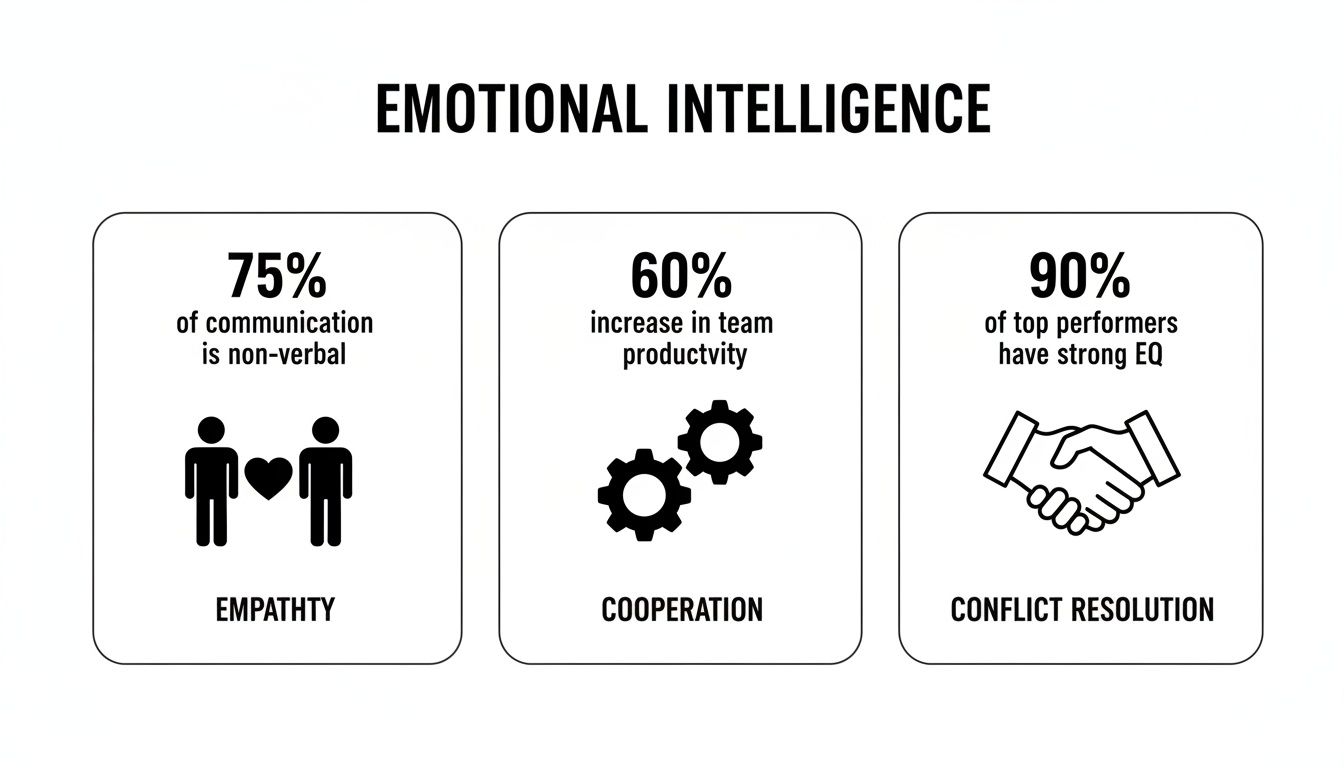
As the visual shows, play is a natural training ground for emotional intelligence—a skillset absolutely critical for success in school and in life.
Why It Works Across Cultures
The universal success of play-based learning comes down to one simple fact: it aligns perfectly with how children are wired to learn. No matter where a child grows up, their brain develops through exploration, trial-and-error, and social connection. Play is the natural arena for all of this to unfold.
This approach respects the way kids actually learn by:
- Tapping into Intrinsic Motivation: Kids are born curious. Play gives that curiosity a purpose, making learning feel like an adventure they chose, not a chore they were assigned.
- Creating a Safe Space to Fail: When a block tower tumbles or a game’s rules need a reboot, it's not a failure—it's just part of the process. This builds resilience and a growth mindset, which are essential for tackling any future academic challenge.
- Making Learning Multi-Sensory: Play is hands-on. It involves seeing, touching, hearing, and doing. This rich, sensory engagement forges much stronger neural connections than a worksheet ever could.
The global evidence is overwhelming. From small classroom studies to large national trials, the message is the same. Investing in high-quality, play-based education pays dividends not just in happy, engaged kids, but in the core academic skills that build a foundation for a lifetime of learning.
Bringing Play-Based Learning to Life
Understanding the "why" behind play-based learning is the easy part. Actually putting it into practice can feel a little more daunting. But here's the good news: creating a rich, playful learning environment isn't about buying expensive, high-tech toys. It's about a shift in mindset—seeing the world of learning that exists in everyday objects and experiences.
This is your practical toolkit for turning any space into one that naturally sparks curiosity and exploration. And it all begins with the materials you choose.
Creating Invitations to Play
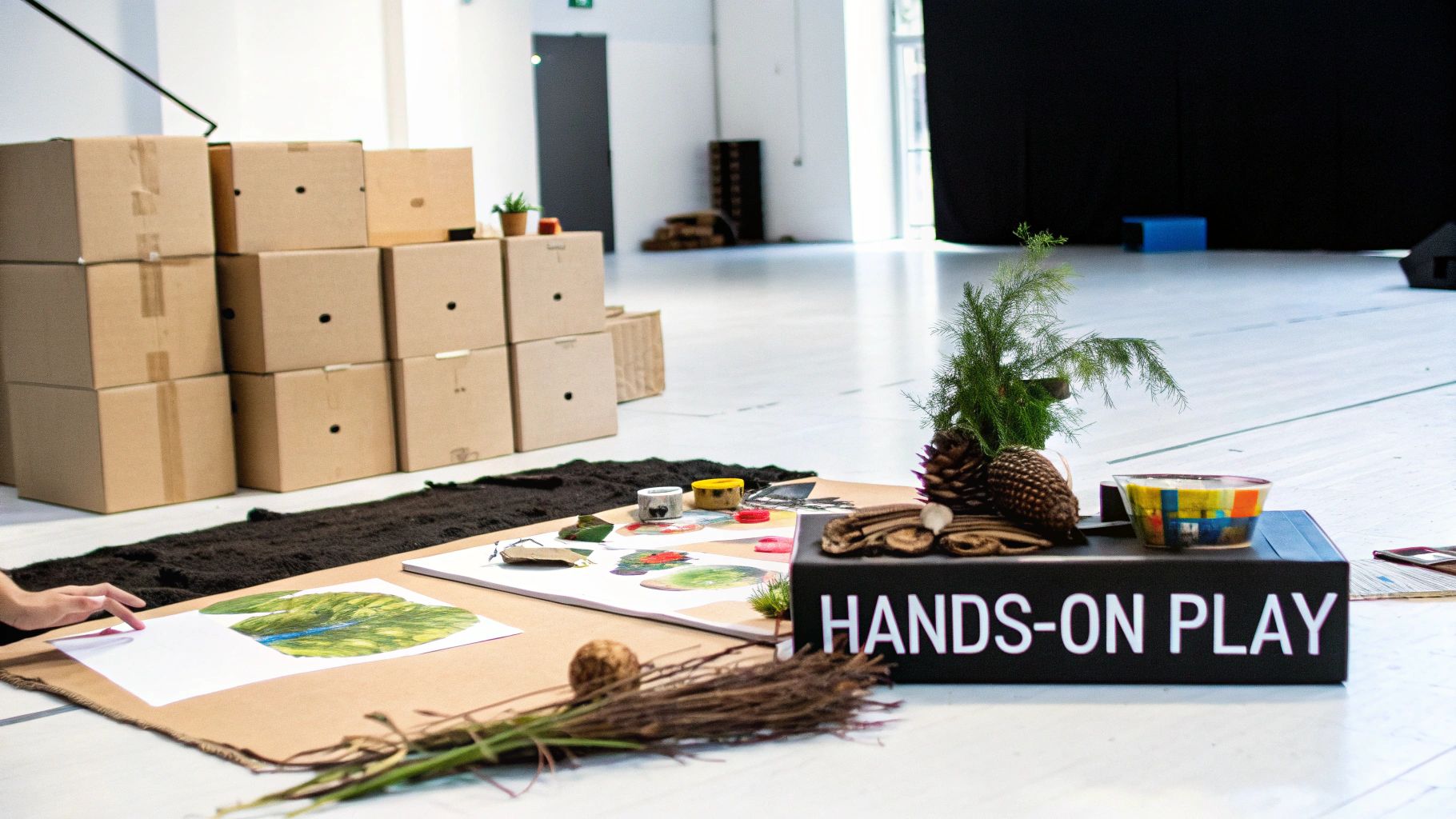
Often, the most powerful learning tools are the simplest ones. We're talking about open-ended materials, which are just items that can be used in a thousand different ways, limited only by imagination. A video game controller does one thing. A cardboard box? It can be a race car, a castle, a spaceship, or a secret hideout.
The core idea is to create an "invitation to play"—a carefully arranged set of materials that sparks curiosity and encourages a child to dive in and explore without specific instructions. This simple setup respects the child's ability to direct their own learning.
Here are a few easy, low-cost ideas you can set up in just a few minutes:
- Nature Explorer Station: Go on a walk and collect interesting leaves, sticks, smooth stones, and pinecones. Lay them out with a magnifying glass and some paper for rubbings, and you've got a mini-science lab.
- Cardboard Construction Zone: All those empty boxes, paper towel tubes, and a roll of tape? That’s an instant engineering workshop for building forts, robots, or entire cities.
- Simple Art Provocation: Place a set of watercolors, some thick paper, and a small jar of water on a tray. This minimalist setup is far less overwhelming than a giant art caddy and helps children focus.
These simple setups empower children to be creators, not just passive consumers of entertainment.
Weaving Play Into Learning Goals
For educators, a common question is how to align this child-led exploration with specific curriculum objectives. The secret is observation. It becomes your most powerful teaching tool. Instead of leading with direct instruction, you can gently guide learning by watching how children play and then asking thoughtful, open-ended questions.
For example, let's say your goal is to introduce early math concepts. You might see a child stacking blocks and ask, "I wonder how many blue blocks it would take to make a tower as tall as this red one?" Just like that, you've connected their play to ideas of measurement and counting in a way that feels completely natural.
This approach proves that powerful learning doesn't depend on a big budget. In fact, one study of a play-based program in rural Ghana saw huge gains in literacy, fine motor skills, and executive function using only low-cost, locally sourced materials and trained volunteers. This shows how adaptable and effective play-based models can be anywhere. You can discover more about how playful learning improves children's outcomes on a global scale.
Ultimately, bringing play-based learning to life is all about shifting your perspective. It’s about trusting a child's innate curiosity and giving them the simple, flexible tools they need to build their own understanding of the world around them.
Common Questions About Play-Based Learning
Even with all the compelling evidence, it's completely normal for parents and educators to have some questions. Moving away from a familiar, structured model toward something more child-led can feel like a big step into the unknown. Let’s walk through some of the most common concerns I hear all the time.
One of the biggest worries is about academic rigor. People often ask, "But will they still learn their ABCs and 123s without worksheets and drills?" The answer is a wholehearted yes—the how is just different and, frankly, more effective.
In a play-based classroom, academic concepts are naturally woven into activities that genuinely fascinate a child. For instance, a group of kids running a pretend "bakery" with play-dough cookies isn't just messing around; they're practicing counting, sorting, one-to-one correspondence, and even the basics of commerce. This kind of learning, rooted in a meaningful context, sticks with them far better than rote memorization ever could.
How Do You Know a Child Is Actually Learning?
This is a great question. Without tests and quizzes, how can you possibly track progress? Teachers in play-based settings become expert observers. They are trained to see the learning happening in every interaction.
They document this growth through detailed notes, photographs of projects in action, and portfolios that showcase a child’s work over time.
Progress isn't measured by a test score, but by observing a child's growing ability to solve complex problems, negotiate with peers, and apply creative thinking to new challenges. These are the foundational skills for all future academic success.
This approach gives you a much richer, more holistic picture of a child’s development, capturing the kind of real-world skills that standardized tests simply can't measure.
Will My Child Be Ready for Kindergarten?
For many parents, this is the bottom line. The truth is, the skills that really matter for kindergarten readiness go far beyond knowing the alphabet. The most critical skills are things like self-regulation, genuine curiosity, and the ability to work collaboratively with others.
And guess what? A play-based education is the absolute best training ground for developing those exact skills.
Children who come from these programs often start kindergarten with a real love for learning and a strong sense of independence. They’re confident problem-solvers, ready and genuinely excited to take on the challenges of a more formal school environment.
At Learning Through Play, we're passionate about nurturing these essential skills. Explore our resources to see how you can support a child's natural curiosity and build a foundation for lifelong success. Discover more by visiting our Learning Through Play resource hub.