
Choosing the right Montessori toys by age isn't about finding the most complex or flashy gadget. It's about finding simple, purposeful items that meet your child exactly where they are in their development. Think natural materials and a focus on one skill at a time. This way, play becomes what it's meant to be: not just fun, but meaningful work.
Understanding the Montessori Approach to Play
Imagine a toy that acts less like a distraction and more like a friendly guide for your child’s curious mind. That's the whole idea behind Montessori toys. At its core, the Montessori philosophy sees play as a child's most important work—and it's not just aimless fun. It's purposeful, self-directed activity that fully absorbs them.
Instead of overwhelming a child with a chaotic mix of lights and sounds, these toys are intentionally simple. You'll often find them crafted from natural materials like wood, wool, or metal. This provides a rich sensory experience that helps ground a child in the real world. The design is clever in its simplicity, usually zeroing in on a single skill or concept.
The Power of Purposeful Simplicity
Think about the difference between a typical battery-operated toy and a simple wooden puzzle. The electronic gadget often does all the "work," asking the child to just watch passively. The wooden puzzle, on the other hand, demands active engagement. Your child has to use their hands, solve a problem, and feel that amazing sense of satisfaction when the pieces finally fit. This hands-on process is absolutely vital for building cognitive pathways and fine-tuning motor skills.
"The hands are the instruments of man's intelligence." - Maria Montessori
This famous quote from Maria Montessori captures the idea perfectly. Children learn by doing, and Montessori toys are the tools for that important work. Many are designed to be self-correcting, which means a child can spot their own mistake without an adult needing to step in. A classic ring stacker, for example, only fits together one way, letting a child figure out size and order all on their own through simple trial and error.
Core Principles Guiding Toy Selection
When you understand the philosophy behind choosing Montessori toys by age, you can make much more intentional choices for your child. It’s less about buying specific "Montessori-branded" items and more about adopting a certain mindset.
Here are the key principles to keep in mind:
- Child-Led Learning: The best toys invite exploration rather than demanding a specific outcome. This allows your child to discover the toy's purpose on their own terms.
- Isolation of a Skill: Each toy should have a clear, singular goal. Maybe it's developing the pincer grasp or understanding that things still exist even when you can't see them (object permanence). This focus prevents confusion and helps them build a sense of mastery.
- Based in Reality: You'll notice many toys mimic real-world tools and activities—think small pitchers for pouring or child-sized cleaning sets. This helps children make sense of and feel capable within the world around them.
Focusing on these ideas helps you cut through the noise of the toy aisle and pick out items that will genuinely support your child’s growth. It sets the stage for choosing the perfect tools for each age, helping foster concentration, problem-solving skills, and a true love of learning.
Montessori Toys for Infants 0-12 Months
The first year of a baby's life is a sensory explosion. Their brain is developing at a pace that is nothing short of incredible, transforming a tiny newborn who can barely see past your face into a curious, crawling explorer. Montessori toys for this age are designed to honor that journey. They are simple, beautiful tools that support a baby’s natural development without ever being overwhelming.
This focus on purposeful, developmental play is why the Montessori toy market has seen such a boom. One recent analysis valued it at USD 8.55 billion, with projections suggesting it could climb to USD 16.25 billion by 2032. Sensory toys, especially those made from natural materials like wood, are a huge part of this, giving babies the essential tactile feedback their developing senses crave. You can dig into more data on this growing market for educational toys.
Visual and Auditory Development 0-6 Months
In those very first weeks, a baby's world is a gentle blur of light and shadow. Their vision is just coming into focus, which is why high-contrast images are so captivating for them. This is where classic Montessori mobiles come in.
- Munari Mobile (0-2 months): Features simple, black-and-white geometric shapes that float gently in the air, helping an infant practice tracking and focusing their eyes.
- Octahedron Mobile (2-3 months): Introduces the primary colors—red, yellow, and blue—right around the time a baby's color perception starts to kick in.
- Gobbi Mobile (3-4 months): Presents a series of spheres in graduated shades of a single color, which helps infants begin to perceive depth and subtle tonal differences.
As their hearing sharpens, simple sounds become a source of fascination. A wooden rattle or a small bell tied to a ribbon provides immediate auditory feedback, teaching a profound lesson: "My movement can create a sound." This is one of their first, powerful experiences with cause and effect.
The goal isn’t to entertain, but to engage. Each toy should offer a specific, manageable challenge that allows the infant to build concentration and a sense of mastery, right from the very beginning.
This timeline beautifully illustrates the core philosophy of providing simple, child-led tools for purposeful play.
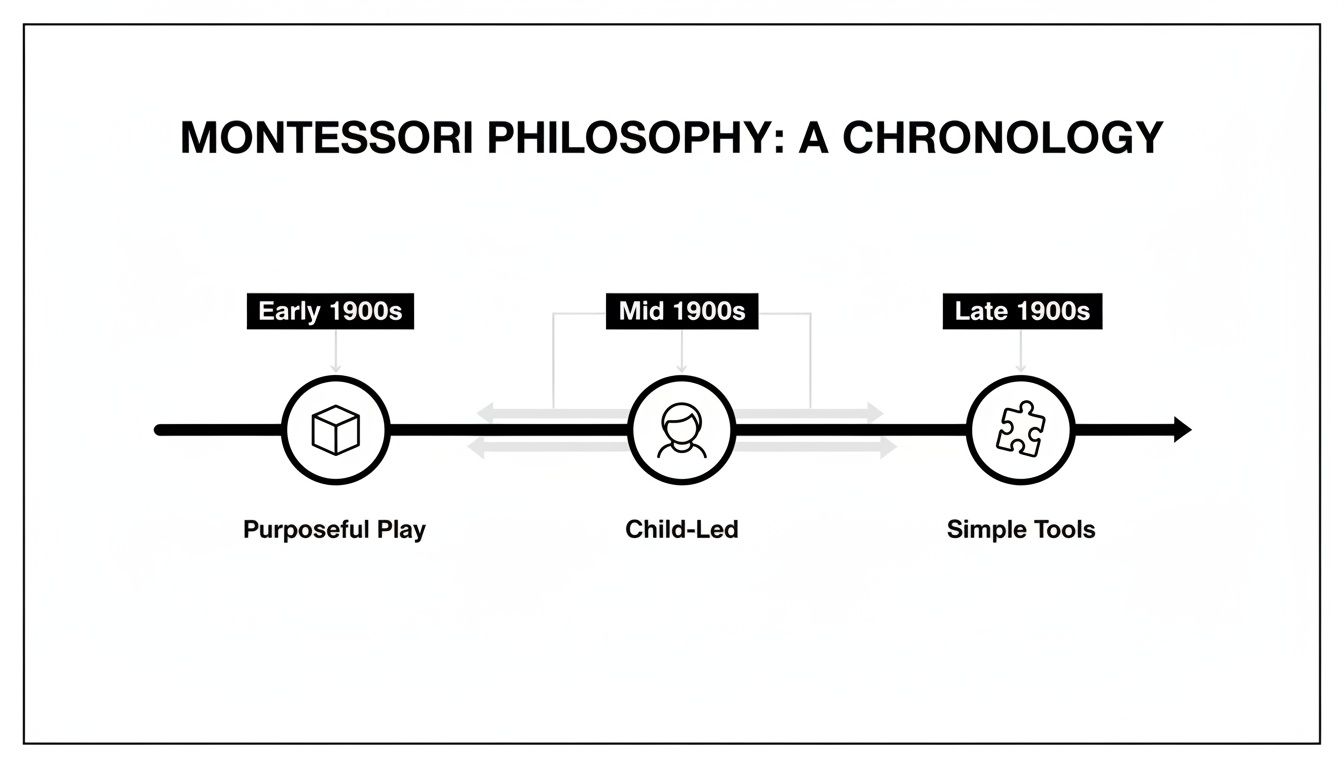
You can see how each stage builds on the last, moving from guided, purposeful interaction toward independent, child-led exploration with simple, effective tools.
To help you connect the dots between your baby's growth and the right kind of play, here’s a quick summary of what's happening during their first year and the toys that best support each stage.
Infant Development Milestones and Corresponding Montessori Toys (0-12 Months)
| Age Range (Approx.) | Developmental Milestone | Recommended Toy Type (Example) |
|---|---|---|
| 0-2 Months | Developing focus and visual tracking skills | High-contrast mobiles (Munari Mobile) |
| 2-4 Months | Beginning to perceive primary colors and depth | Color and gradient mobiles (Octahedron, Gobbi Mobiles) |
| 3-6 Months | Exploring cause and effect; developing intentional grasping | Wooden rattles, bells on ribbons, grasping beads |
| 6-9 Months | Refining fine motor skills; passing objects between hands | Puzzle balls, interlocking discs, textured sensory balls |
| 8-12 Months | Understanding object permanence; pulling up to stand | Object Permanence Box, balls, push walkers (Pikler Triangle) |
| 10-12+ Months | Problem-solving; practicing hand-eye coordination with purpose | Single-shape puzzles (circle puzzle), ring stackers, shape sorters |
This table serves as a guide, not a strict checklist. The most important thing is to observe your child and see what challenges and discoveries are capturing their interest right now.
Grasping and Motor Skills 6-12 Months
Once your baby starts gaining more control over their body, their play becomes much more active and intentional. They are now working hard to coordinate their hands and eyes, driven by an intense desire to reach for, grab, and manipulate everything in sight.
The right Montessori toys by age for this stage are all about supporting this budding dexterity. A puzzle ball, with its easy-to-grab segments, is perfect for little hands to grip and pass from one to the other. Wooden grasping beads offer a satisfying tactile experience while encouraging the use of both hands together.
Around the 8 to 9-month mark, a baby begins to understand the concept of object permanence—the realization that things still exist even when they can't be seen. This is a massive cognitive leap!
The Object Permanence Box is the classic tool for this stage. It's just a simple wooden box with a hole on top and a tray on the side. The baby pushes a ball into the hole, it vanishes for a second, and then—magic!—it reappears in the tray. This simple, repetitive action reinforces this crucial cognitive milestone in a concrete, hands-on way.
By setting up a safe, uncluttered space with a few of these purposeful toys on a low shelf, you invite your baby to move freely and choose their own "work." This lays a powerful foundation for a lifetime of curious, self-directed learning.
Montessori Toys for Toddlers 1-3 Years
Welcome to the whirlwind toddler years! Between the ages of 1 and 3, your child’s world explodes with a fierce desire for independence. They want to do everything themselves, and that’s a wonderful thing. This is the perfect time to introduce practical life materials that bridge the gap between watching you do things and learning to do them on their own.
Think of something as simple as a small pitcher for pouring water. It's not just a toy; it's a tool that teaches concentration, coordination, and how to complete a task with a clear purpose.
As your child leaves their first birthday behind, you'll notice this drive for mastery grow every day. If you're looking for more ideas to channel this energy, it can be helpful to explore resources on the best educational toys for 1-year-olds to keep up with their incredible growth.

Benefits of Practical Life Activities
Practical life activities are so much more than just busy work. They are the heart of the Montessori toddler environment, helping children build real skills and genuine independence. Activities like pouring, scooping, and buttoning allow toddlers to safely practice the everyday tasks they see you doing.
- Small Pitcher: Offers a hands-on lesson in volume and how to control movements.
- Child-Sized Broom: Invites them to help with sweeping, which strengthens gross motor skills and gives them a sense of responsibility.
- Button Frame: Helps refine the fine motor skills needed to master dressing themselves.
- Plant Watering Can: Encourages a gentle sense of care for living things and teaches them to follow a sequence of steps.
"Practical life work invites focus and cultivates responsibility," Maria Montessori observed.
When a toddler successfully completes one of these tasks, you can see the confidence radiate from them. The work is real, and so is their sense of accomplishment.
Developing Fine Motor Precision
As toddlers move toward ages two and three, their focus sharpens, and they become fascinated with refining their hand-eye coordination. This is when materials like knobbed puzzles and threading beads become incredibly engaging, laying the groundwork for skills they'll need later, like writing.
- A Knobbed Puzzle helps a child learn to recognize shapes while mastering the pincer grasp—that all-important ability to pick things up with the thumb and forefinger.
- Ring Stackers introduce early concepts of sequencing and size comparison.
- Threading Beads onto a wooden rod is a fantastic way to build patience and precision.
These might seem like simple games, but they are powerful exercises that strengthen finger muscles and build the ability to concentrate.
Early fine motor success builds confidence and curiosity in toddlers.
By the time they are three, many toddlers can combine these skills into more complex activities, showing just how far they've come.
| Skill Milestone | Toy Example | Learning Outcome |
|---|---|---|
| Pouring and Scooping | Small Pitcher Set | Hand-eye coordination and focused control |
| Sweeping and Tidying | Child-sized Broom | Gross motor skills and sense of order |
| Shape Sorting | Knobbed Puzzle | Fine motor control and problem-solving |
| Bead Threading | Threading Beads | Patience and precision |
This range of purposeful materials keeps toddlers captivated and eager for the next challenge.
Safety and Setup Tips
Safety is always the top priority. Always choose toys made from natural, non-toxic materials, and make sure there are no small parts that could become choking hazards.
The environment itself is just as important. Arrange a low shelf or tray where your toddler can see and access each activity on their own. This empowers them to make choices and work independently.
- Check each toy weekly for any signs of wear, like splintering wood.
- Secure any heavy items or shelves to the wall to prevent tipping.
- Place a soft mat or rug in their play area to cushion any potential falls.
A tidy and predictable space helps a toddler focus and reduces frustration.
Toddlers focus best in environments that feel inviting and uncluttered.
Watching your toddler at play is your best guide. It will tell you when they've mastered an activity and are ready for something new.
Troubleshooting Toddler Engagement
What if your toddler suddenly loses interest in an activity they used to love? It’s completely normal! The key is to rotate materials. After a few days or a week, swap out an activity for something new to reignite their curiosity.
If you see signs of frustration, it might mean the task is a bit too challenging for them right now. It's okay to take a step back and reintroduce a simpler activity where they can feel successful.
- Offer a choice between two activities to respect their growing autonomy.
- Model how to use a material by doing it yourself slowly and deliberately, then step back and let them try.
- Simplify their space by removing distractions. Sometimes, having fewer options visible can lead to deeper focus.
A consistent presentation helps toddlers feel secure, which encourages them to explore more deeply.
A prepared environment is the silent teacher for a toddler’s growing independence.
Key Takeaways for the Toddler Stage
Montessori toys for toddlers are designed to bridge the gap between simple play and learning real-world skills.
- Focus on purposeful actions like pouring, scooping, and sweeping to build their confidence and independence.
- Rotate materials every 2-3 weeks to keep their interest high and their minds engaged.
- Observe your toddler and adjust the complexity of activities to match their current abilities and prevent frustration.
- Create a calm, accessible space with low shelves and just a few well-chosen items available at a time.
Embracing this period of incredible growth sets the stage for a confident, curious learner who truly delights in mastering new skills. When you offer the right tools at the right time, you're encouraging their natural drive to do it all by themselves.
The right environment turns mundane tasks into joyful learning.
By thoughtfully selecting Montessori toys by age, you honor your child's unique developmental rhythm and nurture a lasting sense of confidence. Start today by choosing one new activity that aligns with what your toddler is most curious about, and then watch their skills blossom through meaningful play.
Montessori Toys for Preschoolers: Ages 3-6
Once your child hits three, their world explodes. They move beyond simple imitation and into a vibrant, imaginative space where the big "why" questions start to pop up constantly. This is an incredible period of cognitive growth, and the Montessori toys for this age evolve right alongside them. They transform from tools for mastering motor skills into keys that unlock the worlds of math, language, and logic.

It’s no surprise that this age group’s need for more structured learning is being noticed. Market trends show that home use is expected to make up over 60% of the Montessori toy market by 2028, reflecting a global shift as parents create rich learning environments at home. For kids aged 3-5, materials that sharpen problem-solving are perfect, while older preschoolers are ready to transition to foundational math tools. You can dive deeper into how home environments are shaping the Montessori toy market if you're curious.
Making Abstract Ideas Concrete
Here's where the real magic of Montessori materials for preschoolers comes into play: they make abstract concepts tangible. A child can literally hold and feel ideas like dimension, quantity, and sound, building a deep, physical understanding that screens and worksheets just can't replicate.
These aren't just toys; they are meticulously designed learning instruments.
- The Pink Tower: This iconic material is a set of ten pink cubes that increase in size. As a child builds the tower from biggest to smallest, their hands and eyes learn to discriminate subtle differences, internalizing the concepts of dimension and volume.
- The Broad Stair (Brown Stair): A set of ten brown prisms, all the same length but with varying height and width. When used with the Pink Tower, it introduces a second dimension, opening up more complex ways to explore spatial relationships.
These sensorial materials lay the groundwork for more complex learning, preparing a child's mind for order, sequence, and logic.
By isolating a single quality—like size or color—these materials allow the child to focus deeply and achieve a state of concentration, which is the very foundation of learning.
The Genius of Self-Correcting Materials
One of the most empowering features of Montessori toys for this age is their self-correcting design. This brilliant element allows a child to spot and fix their own mistakes without an adult pointing them out. It’s a quiet, respectful way to build independence and resilience.
Take the Cylinder Blocks, for example. Each cylinder fits perfectly into only one specific hole. If one is out of place, there will either be a cylinder left over or an empty hole at the end. The material itself gives the feedback, inviting the child to solve the puzzle.
This process is incredibly powerful. It teaches children to trust their own judgment, to see mistakes not as failures but as clues, and to keep trying until they figure it out.
Building Foundations for Language and Math
The preschool years are a sensitive period for both language and mathematical understanding. Montessori materials for this stage introduce these concepts in an intuitive, hands-on way that just makes sense to a young child.
Early Language Tools
- Sandpaper Letters: These cards feature lowercase letters in a sandpaper texture. The child traces the letter with their fingers while saying its sound, creating a powerful multisensory link between the tactile shape and the phonetic sound. This prepares the hand for writing long before they ever pick up a pencil.
- The Moveable Alphabet: Imagine a big box filled with multiple copies of each letter. With this, children can "write" words and stories by arranging the letters, even if their fine motor skills aren't quite ready for a pen.
Foundational Math Materials
- Number Rods: A set of ten rods that grow in length from 10cm to a full meter, marked with alternating red and blue sections. Children can physically hold and compare quantities, feeling the concrete difference between "two" and "seven."
- Sandpaper Numbers: Just like the letters, these allow a child to trace the shape of the numeral while saying its name. This links the abstract symbol to the concrete quantity they learned with the rods.
By moving from the concrete (the physical rods) to the abstract (the written numeral), children build a solid, unshakable foundation in mathematics. They discover that math isn't about memorization; it's a logical, predictable, and fascinating system they can explore with their own two hands.
How to Choose and Rotate Montessori Toys
Building a thoughtful play space isn't about having more toys; it's about having the right ones. When you're picking Montessori toys by age, the goal is to find simple, purposeful tools that invite your child to become deeply engaged, rather than just creating a room full of distracting clutter.
So, what makes a toy "Montessori-aligned"? They usually share a few key traits that make them stand out from the bright, noisy options in most toy aisles.
First, look for things made from natural materials—think wood, wool, or metal. These materials give a child so much more sensory information than plastic does. A wooden block has a certain weight, texture, and even temperature that teaches a child about the world around them in a very real, tangible way.
Second, a true Montessori toy is rooted in reality. It often looks like a miniature version of a real-world object, like a small pitcher for pouring or a child-sized broom. This isn't just about "playing house"; it's about empowering children to master practical skills and feel capable and included in everyday life.
Finally, each toy should isolate a single, specific skill. A simple ring stacker is purely about learning to discriminate between different sizes. A puzzle with a single shape helps a toddler perfect their pincer grasp. This intentional simplicity cuts through the noise, allowing a child to focus completely on the task at hand. That's how they build true concentration and confidence.
The Art of Toy Rotation
Once you have a small collection of high-quality toys, the real magic comes from how you present them. This is where toy rotation comes in. It’s a beautifully simple but incredibly effective strategy for keeping playtime fresh and engaging. Instead of piling everything into a toy box, you'll place just a few items on a low, accessible shelf.
This simple change brings a few immediate benefits:
- It cuts down on the overwhelm. A cluttered room can be really overstimulating for a child, making it hard to focus on anything. Fewer options create a calm, inviting atmosphere.
- It encourages deeper play. When a child only has a handful of toys available, they're much more likely to explore each one fully and discover new ways to use it.
- It keeps things interesting. A toy that’s been put away for a few weeks feels brand new when it reappears. This cycle keeps your child’s interest high without you needing to constantly buy new things.
This philosophy of thoughtful play is really catching on. The Asia-Pacific region, for example, is quickly becoming the fastest-growing market for Montessori toys, with growth projected at 9.5% through 2032. While North America and Europe still lead, this global interest just shows how universally appealing the idea of child-led discovery really is.
Creating Your Rotation System
Getting started with a rotation is easy. Pick about six to ten age-appropriate toys and arrange them on a low shelf where your child can see and reach them independently. The rest of the toys go into storage, out of sight.
Now, just watch your child. When you see them starting to lose interest in a toy, it’s time to swap it out for something from your stored collection.
The core idea is to follow the child. Their play will tell you when they have mastered a skill and are ready for a new challenge, or when an old favorite just needs a little break.
When you're choosing and organizing toys, understanding the "why" behind them is everything. For a deeper dive into creating a space that truly fosters independence, check out this excellent guide on setting up Montessori materials for home. It offers a great framework for making intentional choices that will help you cultivate a calm, inspiring, and educational environment.
Your Montessori Toy Questions, Answered
Diving into the world of Montessori often brings up a few practical questions. As you start looking for Montessori toys by age, it's completely normal to wonder how it all works in a real, busy family. I’ve put together some clear, supportive answers to the questions I hear most often from parents, helping you bring this wonderful philosophy home with confidence.
My goal here is to cut through the confusion and give you realistic strategies that fit into modern life. We'll tackle everything from budget worries to what to do when Grandma buys that flashy, noisy toy.
Do I Really Need to Buy Expensive “Official” Montessori Toys?
Absolutely not. Let's get this one out of the way first: the principles behind the toys are what matter, not a brand name or a hefty price tag. You don't need a big budget to embrace Montessori—you just need a slight shift in how you see play. In fact, many of the best learning activities are probably already in your house.
A toddler fascinated with pouring, for instance, can learn just as much fine motor control with a small pitcher and some dried beans on a tray as they can with a purchased set. Sorting laundry by color or pairing up socks? That's a powerful, real-world lesson in classification, and it's free. The focus is always on purposeful work, not pricey products.
That said, if you are going to spend money, investing in a few high-quality, open-ended items can actually be more economical in the long run. A beautifully made wooden block set, for example, will be used for years in increasingly complex ways, long after dozens of plastic, single-function toys have been forgotten.
The real value of a Montessori toy isn't in its price tag. It's in its ability to draw a child into meaningful, self-directed work. Think purpose, not purchase.
How Should I Introduce a New Toy to My Child?
The Montessori way of presenting a new toy is beautifully simple: it’s slow, deliberate, and full of respect for your child. The idea is to clearly show the toy's purpose without a flood of instructions. This models care for the materials and, more importantly, empowers your child to explore on their own.
Here’s a simple, step-by-step way to do it:
- Choose a Quiet Moment: Find a time when you and your child are both feeling calm and aren't rushed.
- Present with Few Words: Sit with your child and, with intention, show them how the toy works. If it's a puzzle, for example, you might slowly take out one piece and then place it back into its spot. Let your actions do the talking.
- Use Deliberate Movements: Make your movements precise and easy to follow. This isolates the action and helps your child’s brain focus on the toy's function.
- Step Back and Observe: After your brief demonstration, offer the toy to your child. Then, just watch. This is the hardest part! Resist the urge to jump in, correct, or guide them.
Your quiet observation sends a powerful message: "I trust you." Believing in their ability to figure things out is one of the greatest gifts you can give them.
What If My Child Ignores a New Montessori Toy?
This happens all the time, and it’s almost never a big deal. When a child isn't interested in a new toy, it's not a rejection—it's just information. Your job is to be a bit of a detective. Is the toy too simple for where they are right now, making it boring? Or is it maybe a little too advanced, causing frustration?
Sometimes, the timing is simply off. The best solution is often the easiest one: put the toy away. Store it out of sight for a few weeks or even a month. When you bring it out again, it will feel brand new, and you might find your child is in the perfect developmental spot to fall in love with it.
The most important part of the Montessori method is to follow the child. It’s not about forcing an activity but about preparing an environment with appealing, appropriate options. Respecting your child's unique timeline is how you build their inner motivation and a true love for learning.
How Do I Balance Montessori with Gifts from Family?
Ah, the well-meaning gifts from relatives that don't quite fit the Montessori vibe. This can be tricky, but you can absolutely find a balance that honors your parenting choices while still respecting your loved ones. The key is to have a simple, stress-free strategy.
First, set up a dedicated "Montessori shelf" in your main play area. This is where you'll keep the curated, developmental toys that are part of your child’s daily rotation. The other toys—the ones with batteries, flashing lights, and loud sounds—can have their own home in a separate basket or closet. They can come out for special playtimes, but they don’t need to be part of the everyday learning space.
You can also gently guide well-meaning gift-givers before birthdays and holidays.
- Create a Simple Wish List: Share a list with a few specific ideas that fit your philosophy. This is a huge help for relatives who genuinely want to get something your child will use and love.
- Suggest Experience Gifts: Ask for a pass to a local children's museum, a contribution toward swimming lessons, or tickets to a concert. These gifts create lasting memories without adding clutter.
- Request Books: You can almost never go wrong with a beautiful, well-written book. It’s a wonderful gift that aligns perfectly with Montessori values.
At the end of the day, it's all about gratitude and compromise. A few non-Montessori toys aren't going to derail your child's development. What matters most is creating a loving, supportive family—and that’s just as important as curating the perfect shelf.
At Learning Through Play, we believe in giving parents the tools and knowledge to foster a natural love of learning. Our curated selection of toys is designed to support each developmental stage with purpose and joy. Discover the perfect materials to inspire your child's journey. Explore our collection today!