
Have you ever watched a toddler painstakingly try to button their own coat, or a preschooler struggle to hold a crayon just right? It’s a common sight, and the answer to mastering these tasks lies in developing fine motor skills—those tiny, precise movements our hands and wrists make every day.
This guide is all about turning those struggles into successes through simple, playful activities that build a solid foundation for writing, self-care, and lifelong independence.
What Are Fine Motor Skills and Why Do They Matter So Much?
Simply put, fine motor skills are the coordinated efforts between the small muscles in the hands and fingers and our eyes. But they're far more than just "small movements." They are the absolute bedrock of a child's ability to be independent and ready for school.
Every single time a child picks up a Cheerio, zips a jacket, or makes a mark with a pencil, they're firing up these critical skills. These intricate movements are also deeply connected to a child's cognitive growth. When kids manipulate objects, they're not just playing; they're learning about cause and effect, figuring out how things fit together, and building spatial awareness.
The Foundation for Big Achievements
I like to think of fine motor development like building a house. You can't put up the walls and roof (writing, tying shoes) without first pouring a strong, stable foundation. That foundation is built through seemingly simple, repetitive play.
Activities that strengthen these foundational muscles include:
- Grasping: Scooping up blocks, grabbing small toys, or picking up pieces of a puzzle.
- Pinching: Using that all-important pincer grasp (just the thumb and index finger) to handle things like beads, clothespins, or pasta shapes.
- In-hand manipulation: This is a tricky one! It's the ability to move an object around within one hand, like repositioning a crayon to get a better grip without using the other hand.
- Bilateral coordination: Getting both hands to work together as a team, like when you hold the paper with one hand while cutting with scissors in the other.
Mastering these small movements does more than just prepare a child for kindergarten. It builds a powerful sense of "I can do it!" that fuels their confidence to learn and explore everything else.
Weaving Practice into Everyday Life
Here's the best part: you don't need a curriculum or expensive, specialized toys. Opportunities to practice fine motor skills are literally everywhere, woven into the fabric of your day.
Inviting your child to help with simple household tasks is one of the most effective and natural ways to build hand strength. Stirring pancake batter, snapping green beans for dinner, or even spritzing plants with a spray bottle are all fantastic, screen-free ways to get those little muscles working.
When you turn these everyday moments into playful practice, skill-building feels less like a chore and more like a fun discovery. You’re helping your child lay the groundwork for future success, one tiny, powerful movement at a time.
Your Guide to Fine Motor Milestones and Activities
Think of fine motor development as a roadmap for your child's first few years. While every child hits these milestones on their own schedule, knowing what's coming can help you offer the right kind of playful support when they need it most. This guide breaks down what to look for at each age and pairs it with simple, fun activities that make building these crucial skills feel like a game.
This is all about connecting the dots—from those first clumsy grabs to the refined movements needed for writing, getting dressed, and thriving in school.
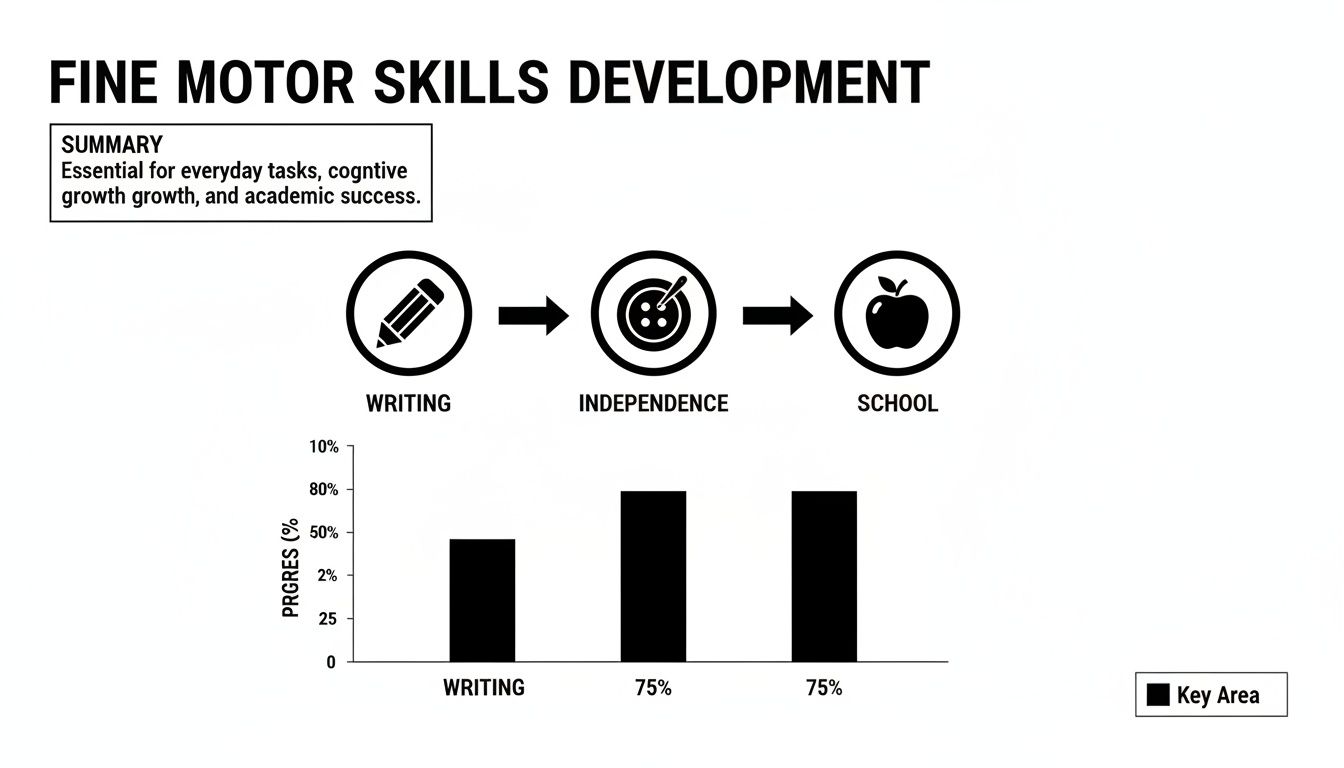
As you can see, these small hand movements are the foundation for some pretty big life achievements.
Infants: 0 to 12 Months
The first year is a whirlwind of discovery, and a baby's hands are their main tools for exploring the world. Everything starts with reflexes and slowly, month by month, becomes more intentional and controlled.
A newborn’s grasp is pure instinct. Put your finger in their palm, and they’ll automatically curl their tiny fingers around it. But over the first few months, that reflex gives way to purposeful action. Around 3-4 months, you'll start to see them reaching and batting at toys—their aim might be a little off, but this is a huge leap for hand-eye coordination.
As they get more control, you’ll notice them:
- Raking objects closer: Using their whole hand like a little rake to drag a toy in.
- Passing things between hands: Around the 6-month mark, they master the tricky skill of moving an object from one hand to the other.
- Developing the pincer grasp: This is the big one. Between 9-12 months, they’ll start using their thumb and forefinger to pick up tiny things, like a single cheerio or a crumb off the highchair.
Activities for Infants
Your main job here is to create a safe, stimulating space for them to explore. You don't need fancy gadgets; simple, everyday items are usually the best.
- Tummy Time Fun: During tummy time, place a few interesting, baby-safe toys just out of reach to encourage them to reach and grab. A colorful rattle or soft, crinkly book works wonders.
- DIY Sensory Bags: Fill a zip-top bag with a little hair gel and some small, smooth items (like big buttons—and tape that bag shut securely!). They can squish and move the items with their fingers without any choking hazard.
- Finger Foods: Once they're ready for solids, offering soft, safely-sized finger foods like cooked peas or tiny pieces of banana is the best real-world practice for that pincer grasp.
Toddlers: 1 to 3 Years
The toddler years are defined by that fierce "I do it myself!" attitude. This drive for independence is the perfect motivation for honing more advanced fine motor skills. Their movements get much more refined as they figure out how to control their fingers and wrists with more precision.
You'll see their abilities explode during this stage. They might go from stacking just two blocks to building impressive towers. Their artistic side also emerges, shifting from scribbling with a fist-grip to holding a crayon with their fingers.
A key thing to remember at this age is that repetition is everything. The more a toddler practices a skill—like fitting a puzzle piece or snapping a block into place—the stronger and more coordinated their hand muscles become.
Activities for Toddlers
Play gets much more imaginative and complex now. The best activities are open-ended, giving them room to explore and create.
- Play-Doh Power: Squeezing, rolling, pinching, and squishing Play-Doh is a fantastic workout for their little hands. Add some kid-safe plastic knives or cookie cutters for extra practice.
- Simple Puzzles: Start them off with chunky wooden puzzles with large knobs, then gradually introduce more complex interlocking ones. It’s great for spatial awareness and problem-solving.
- Water Play: A bin of water with some cups, sponges, and droppers can keep them busy for ages. Scooping, pouring, and squeezing are all brilliant for building hand strength.
For older toddlers, diving into engaging art and crafts activities for toddlers can give their hand-eye coordination and creativity a real boost.
Preschoolers: 3 to 5 Years
By the time they're in preschool, kids are becoming incredibly capable with their hands. This is the age where they really start to fine-tune the skills needed for writing and more complex self-care tasks. You’ll also notice their hand dominance—whether they're a righty or a lefty—becoming much more obvious.
A 3-year-old might be able to snip at paper with scissors, while a 5-year-old can often cut along a straight line. Their drawings transform from scribbles into recognizable people and objects. They're also mastering buttons, zippers, and maybe even starting the long journey of learning to tie their shoes.
It's worth noting that progress isn't always a straight line, and some kids get frustrated. Did you know that around 5% to 10% of elementary school children struggle with fine motor delays? This can affect everything from buttoning a coat to writing. The good news is that research shows consistent practice, just 15-20 minutes a day, can make a huge difference.
Activities for Preschoolers
Activities for this age group should focus on precision, control, and using both hands together.
- Bead Threading: Stringing large beads onto a shoelace or pipe cleaner is fantastic for hand-eye coordination and requires a very deliberate pincer grasp.
- Cutting Practice: Give them child-safe scissors and a variety of materials to cut—old magazines, construction paper, or even Play-Doh "snakes." Start with simple snips and work up to cutting along lines.
- Building with Blocks: LEGOs, Magna-Tiles, or classic wooden blocks are perfect. They encourage precise placement and creative thinking, all while strengthening fingers and hands.
Early School Age: 5 to 7 Years
Once kids hit elementary school, their fine motor skills become highly specialized. The focus shifts toward academic tasks like handwriting, along with mastering all the little life skills that require dexterity.
Their handwriting becomes much more controlled and easier to read, moving from big, printed letters to smaller, neater text. They can finally tie their own shoes, use a fork and knife properly, and handle tools like rulers and hole punches with confidence. This is the payoff for all those years of playful practice.
Activities for Early School-Age Kids
While activities can be more goal-oriented at this stage, the key is to keep them fun to avoid burnout.
- Origami and Paper Airplanes: Folding paper requires precision, the ability to follow directions, and using both hands in coordination.
- Detailed Coloring and Drawing: Using colored pencils to fill in intricate coloring books or learning to draw specific objects helps refine their pencil control.
- Model Building: Simple model kits with snap-together pieces are excellent for developing dexterity and the focus needed to follow multi-step instructions.
To make it even easier, here's a quick-reference guide matching playful activities to key developmental stages. It's a great tool to help you choose the right challenges at the right time.
Fine Motor Activities by Age Group
| Age Group | Key Milestones | Recommended Activities | Materials Needed |
|---|---|---|---|
| Infants (0-12 mo) | Reaching, grasping, raking, transferring objects, developing pincer grasp. | Tummy time with toys, playing with soft blocks, finger feeding. | Rattles, soft toys, baby-safe blocks, puffs or soft foods. |
| Toddlers (1-3 yrs) | Stacking blocks, scribbling, turning pages, starting to use utensils. | Play-Doh, simple puzzles, finger painting, water play with cups. | Play-Doh, chunky puzzles, washable paint, water bin, cups. |
| Preschool (3-5 yrs) | Drawing shapes, cutting with scissors, buttoning clothes, building complex structures. | Bead threading, cutting practice, LEGOs, dressing up with zippers/buttons. | Large beads, string, child-safe scissors, paper, building blocks. |
| School Age (5-7 yrs) | Writing legibly, tying shoes, detailed drawing, using tools. | Origami, detailed coloring books, model building, learning to knit or sew. | Paper, colored pencils, model kits, shoelaces, yarn. |
By matching the right activities to each stage of your child's development, you can effectively support their journey toward mastering the small movements that unlock big independence.
Why Play Is the Secret Ingredient for Strong Motor Skills
We all know instinctively that kids learn through play. It’s a common saying. But what's really going on beneath the surface is a remarkable mix of brain science and physical development. Play isn't just about killing time; it's the single most powerful engine for building fine motor skills.
When a child is lost in a playful activity they genuinely love, their brain lights up and becomes incredibly receptive to learning. This isn't like a structured drill that can feel like a chore. Play creates a space where a child can repeat an action hundreds of times without getting bored or frustrated, which is exactly how strong muscle memory and neural pathways are built.
The Hidden Genius in Simple Toys
Think about a toddler trying to build a block tower. To us, it’s just a game. To them, it's a high-stakes lesson in dexterity, physics, and creative problem-solving all rolled into one.
Every time they reach for a block, their brain is making a complex calculation about distance and trajectory. As they carefully place it on the stack, they’re making tiny, subconscious adjustments to their grip and wrist angle to keep the whole thing from crashing down. It's a hands-on masterclass in:
- Hand-Eye Coordination: Syncing up what their eyes see with what their hands do.
- Graded Force: Figuring out the perfect amount of pressure—not too hard, not too soft.
- Spatial Awareness: Understanding how objects fit together in the real world.
Best of all, they're learning this organically, driven only by the desire to build something awesome. There’s no pressure to perform, which frees them to experiment, fail, and try again. That self-motivated repetition is the magic that solidifies fine motor control.
Play transforms skill-building from a conscious chore into an unconscious, joyful process. A child isn't thinking, "I must now practice my pincer grasp." They're thinking, "I need this tiny LEGO to fit right here!"
How Playful Moments Build a Smarter Brain
The link between strong hands and a strong mind is more direct than most people think. The benefits of play-based motor development go far beyond just being able to hold a crayon. These early physical skills actually lay the foundation for future cognitive and academic success.
When a child is manipulating small objects, they're firing up multiple regions of their brain at once. The focus, planning, and execution needed for things like stringing beads or molding clay helps develop crucial executive functions—the mental skills that govern working memory, flexible thinking, and self-control.
This isn't just a theory; it’s backed by some pretty compelling research. A study of 832 kids found that their fine motor skills upon entering school were a significant predictor of later receptive vocabulary, number knowledge, and attention. Interestingly, the effect was even stronger in girls.
When researchers added fine motor mastery into kindergarten readiness models, they found it was a better predictor of later science scores than early math or reading skills were. You can dive into the specifics by checking out the full study. What this tells us is that building blocks, drawing kits, and even a simple tub of putty aren't just toys—they're evidence-based tools for brain development.
From Playtime to Problem-Solving
At its core, play is how children test out their ideas about the world. "What happens if I stack this block sideways?" "Can I use this spoon to scoop the sand?" Each one of these moments is a tiny scientific experiment.
This process of exploration and discovery builds more than just physical dexterity; it builds a resilient, curious, and creative mindset. The child who learns to patiently wrestle two stubborn LEGO pieces together is also building the persistence they’ll need to solve a tough math problem years down the road.
By making space for play, you’re giving your child the most powerful tool there is for developing their fine motor skills. You’re helping them build strong hands, a connected brain, and a confident "I can figure this out" attitude that will serve them for the rest of their lives.
How to Create a Fine Motor-Friendly Home
You don't need a dedicated classroom or a shelf overflowing with expensive "educational" toys to support your child's fine motor development. Honestly, the most powerful learning happens when you use everyday items to turn your home into a space that naturally encourages practice and exploration.
The real secret is to make these skill-building opportunities accessible, visible, and, most importantly, irresistible. By thoughtfully setting up a few small stations or just rethinking how you store art supplies, you can spark a child's natural curiosity. It's all about designing a space where strengthening those little hands is just a normal part of the day.

Design an Irresistible Maker Space
Setting up a dedicated "maker space" or craft corner is a fantastic way to keep creative tools in one place. This doesn't have to be an entire room—a small table, a nook in the kitchen, or even a rolling cart works beautifully. The goal is to make the materials easy for your child to see and get to all on their own.
Stock this spot with open-ended supplies that invite pinching, squeezing, and cutting. We're talking low-cost, high-impact items that can be used in a million different ways.
- Jars of Goodies: Fill clear, kid-safe jars with things like pom-poms, big buttons, dry pasta, or chunky beads.
- Tools for Tinkering: Lay out child-safe scissors, tongs, clothespins, and maybe even some fun tweezers.
- Creative Canvases: Go beyond plain paper. Offer up construction paper, old cardboard boxes, coffee filters, and aluminum foil.
When a child can see all the possibilities and choose for themselves, they're much more likely to dive in. That sense of autonomy is a huge motivator and keeps them happily engaged in skill-building play for much longer.
Master the Invitation to Play
An "invitation to play" is one of my favorite simple-but-powerful strategies. All it means is setting out a few carefully chosen items on a tray or in a small bin to pique a child's interest. It's way less overwhelming than a giant, messy toy box and gently nudges them toward an activity without any rigid rules.
An invitation to play is not about telling a child how to play. It's about creating a question—"What can you do with this?"—and letting them discover the answer with their hands.
For instance, you could set out:
- A tray with a lump of play-doh and some dry spaghetti noodles for poking and building.
- A bowl of water, a sponge, and a turkey baster for squeezing and transferring.
- A piece of string and a handful of rigatoni pasta for a quick threading activity.
These simple, self-contained setups are perfect for targeting specific skills in a fun, no-pressure way. They take minutes to prepare but offer huge benefits, turning a few spare moments into a valuable practice session.
When to Watch and When to Seek Help
It’s one of the most common questions I hear from parents and educators: "Is my child on track?" It's completely natural to wonder, and while every child truly does develop at their own pace, knowing what to look for can help you be their best advocate.
This isn't about creating anxiety. It's about giving you clear, calm information so you can spot potential patterns and know when a conversation with a professional might be a good idea. We’re looking for consistent trends over time, not just a single off-day with the building blocks.
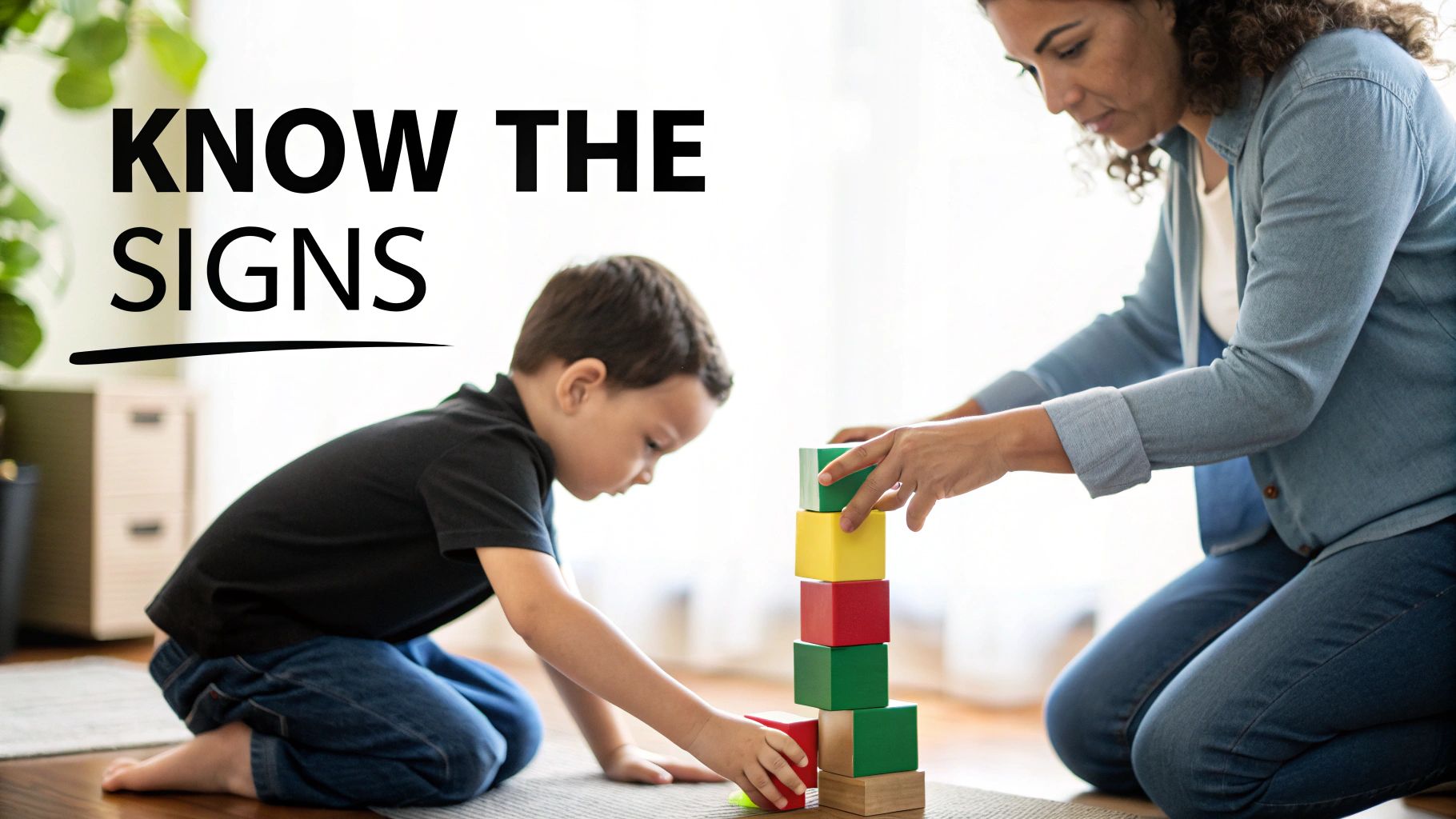
Recognizing Potential Red Flags by Age
The best way to get a feel for your child's progress is by simply watching them during play and daily routines. While this isn't a diagnostic checklist, noticing persistent challenges can be a sign that the small muscles in their hands and wrists could use a little extra support.
Here are a few specific things to keep an eye on, broken down by age.
For Toddlers (1-3 years):
- Awkward or Stiff Movements: Do they use their whole arm and body for a task that should only need their hand, like scribbling?
- Difficulty with Basic Grasping: By 18 months, most toddlers are using a pincer grasp (thumb and index finger) to pick up small things. Is your child still struggling with this?
- Trouble with Simple Stacking: By age two, can they stack two or three blocks, or does the tower always tumble before it even starts?
For Preschoolers (3-5 years):
- Immature Pencil Grip: Are they still holding crayons in a tight fist instead of starting to use their fingertips?
- Avoidance of Fine Motor Tasks: Do they actively shy away from drawing, puzzles, or LEGOs, often saying "I can't do it" before even trying?
- Inability to Use Scissors: By age four, can they make simple snips on paper with child-safe scissors, or do they show little interest or ability?
Keep in mind, these are just guideposts. A child might struggle with one skill while being a rockstar at another. What you're looking for is a consistent pattern of difficulty across several different fine motor activities.
The Connection Between Fine Motor Skills and Overall Health
Addressing these delays is about more than just handwriting or zipping up a coat. Research increasingly shows a deep link between fine motor competence and a child's overall physical health.
For instance, a 2023 study found that for children with global developmental delays, manual dexterity was a major predictor of their total physical fitness. This connection highlights how challenges with small muscle control can ripple out and impact broader physical well-being, making early support a critical piece of the puzzle.
When to Talk to a Professional
If you’ve been noticing several of these signs consistently for a few months, it's worth bringing them up at your child's next pediatrician appointment. Your doctor can do an initial assessment and help you decide if the next step should be a referral to a specialist, like a pediatric occupational therapist (OT).
An OT is an expert trained to help children develop the skills they need for the "jobs" of childhood—playing, learning, and simply growing. They don't just see "problems." They see opportunities to build strength, skill, and confidence through fun, play-based activities.
Catching and addressing fine motor delays early can make a world of difference for a child's development, showcasing the incredible Benefits of Early Intervention. At the end of the day, trust your gut. You know your child better than anyone, and asking questions is the first and most important step toward getting them the support they need to thrive.
Your Top Questions About Fine Motor Skills, Answered
As you guide your child through their developmental milestones, it’s completely normal to have questions pop up. The path isn't always straight, and you might find yourself wondering about anything from how much screen time is too much to how to handle a flash of frustration during practice.
We've pulled together some of the most common questions we hear from parents and educators. Think of this as your quick-reference guide for those moments when you need a clear, expert take.
How Much Time Should We Spend on This Every Day?
There’s no magic number here. The secret sauce is consistency over quantity. If you can find just 15-20 minutes for playful, focused practice each day, you're golden. This doesn't mean you need to schedule a formal "fine motor skills" block in your calendar.
The real goal is to weave these opportunities right into the fabric of your day. You're probably already doing a lot of this without even realizing it.
For instance, practice can look like:
- Letting them help stir the pancake batter in the morning.
- Breaking out the Play-Doh while you're getting dinner ready.
- Tasking them with buttoning their own coat before you head out.
- Stacking blocks or threading pasta onto a string while the bath is running.
Focus on creating these small, frequent moments for them to use their hands. They add up fast and build muscle memory much more effectively than a single, long session that leaves everyone feeling burnt out.
Do I Really Need to Buy Expensive “Educational” Toys?
Absolutely not. While there are some fantastic toys out there designed to support fine motor development, some of the very best tools are likely hiding in your kitchen drawers and craft bins right now. It's always about the action, not the product.
In my experience, simple, everyday items often spark more creativity and hold a child's attention far longer than a fancy toy with only one purpose.
Don't underestimate the power of simple materials. A clothespin can become a puppet, a tool for picking up pom-poms, or just a clothespin. This open-ended potential is where the real learning happens.
Consider these low-cost powerhouses:
- Kitchen Tongs and Tweezers: Fantastic for picking up anything from cotton balls to dry cereal.
- Spray Bottles: Fill one with water and let them "paint" the sidewalk or help water plants. It's an amazing hand strengthener.
- Play-Doh and Clay: All that squeezing, rolling, and pinching builds incredible hand strength.
- String and Dry Pasta: A classic threading activity that costs next to nothing.
What if My Kid Hates Drawing and Writing?
If you notice your child actively avoiding activities like drawing or coloring, forcing it is the last thing you want to do. Resistance is often a signal that they're frustrated or that their hands just aren't strong enough yet, and adding pressure will only make things worse. The trick is to find other ways to build those same foundational skills without the struggle.
Forget the pencil for a while and shift your focus to strengthening their hands and fingers through pure play.
Try getting them engaged with activities that don't feel like "work" at all:
- Go Vertical: Drawing with chalk on the sidewalk or painting with water on an easel changes the wrist position and often feels much more comfortable and natural.
- Get Messy with Sensory Play: Let them finger paint in a dollop of shaving cream or draw in a shallow tray of sand or salt. It takes away all the pressure of holding a tool.
- Break Out the Building Toys: Using LEGOs, Magna-Tiles, or other construction sets builds the exact same dexterity and coordination needed for writing.
Once their hands are stronger and more coordinated, you'll often see them approach drawing and writing with a whole new level of confidence.
What’s the Difference Between Fine and Gross Motor Skills?
This is a great question, and it really gets to the heart of how our bodies learn to move. The two types of motor skills are very different, but they're also a team—they're deeply interconnected and have to work together to help us navigate the world.
Gross motor skills are all about the big muscle groups. These are for powerful, whole-body movements like running, jumping, climbing, and throwing a ball. Think big actions.
Fine motor skills, on the other hand, are about the small, delicate muscles, especially in our hands, fingers, and wrists. These are for precise, controlled actions like writing, buttoning a shirt, or picking up a tiny bead. Think detailed work.
Here’s the thing, though: you can't have one without the other. A strong core and stable shoulders (gross motor) provide the steady base needed for the hands and fingers to do their intricate, detailed jobs (fine motor).
At Learning Through Play, we believe that the best tools for development are often the simplest. Our curated selection of toys and activities is designed to spark curiosity and build essential skills through joyful, hands-on exploration. Discover how our products can support your child's fine motor journey by visiting us at https://admin.shopify.com/store/learningthoughtplay.