
When you're looking for the best educational toys for 5 year olds, think less about flashy gadgets and more about open-ended tools that ignite their imagination. Things like building blocks, art supplies, and simple imaginative play sets are gold at this age. They're not just toys; they’re powerful learning instruments that support the incredible cognitive and social growth spurts happening right now.
Why Play Is the Real Work for a 5 Year Old
For a five-year-old, playtime isn't just about having fun—it's their most important job. This is the age where they make a huge leap from playing alongside friends to creating intricate, imaginative worlds with them. Suddenly, they're inventing rules, assigning roles, and weaving entire stories out of thin air.
Think of your child as an architect, and their brain is the amazing structure they're building. In this picture, educational toys are their high-quality bricks and mortar. Every block they place, every puzzle they solve, and every pretend scenario they act out reinforces that foundation, building skills that will support them for life.
Building Brains, One Block at a Time
Picking out the right educational toys for 5 year olds is about so much more than just keeping them occupied. It’s about giving them the specific tools they need for this amazing developmental journey. When a child really connects with a well-designed toy, they're doing more than just playing—they're literally wiring their brain for future learning.
This guide is your roadmap. We’ll go beyond the marketing hype to show you exactly how certain types of toys connect to key areas of growth. You'll start to see toys not as simple objects, but as catalysts for developing real-world skills:
- Problem-Solving: Figuring out how to keep a wobbly tower of blocks from crashing teaches resilience and logic.
- Emotional Intelligence: Using dolls or puppets to act out different situations helps them explore empathy and see things from another's point of view.
- Collaboration: Working together on a magnetic tile castle is a masterclass in teamwork and communication that no lecture could ever match.
The most effective educational toys are often the simplest. Open-ended toys like blocks, art supplies, and dress-up clothes provide a blank canvas for a child's imagination, offering limitless possibilities for learning and discovery.
From Simple Stacking to Complex Storytelling
The real magic of being five is watching them move from basic cause-and-effect to much more complex thinking. A toddler might just stack blocks to see how high they can go. A five-year-old, on the other hand, builds a fortress, decides which room is the dungeon, and creates a whole story about the knight who lives there. This is where the learning gets deep.
By choosing toys thoughtfully, you're giving them the right materials for this advanced "work." A marble run lets them experiment with gravity. Alphabet puzzles make early literacy fun. Modeling clay helps them perfect the fine motor skills they'll need for writing. Every interaction is a small but vital step toward raising a curious, confident, and capable kid.
What's Happening Inside a 5-Year-Old's Brain?
To find the best educational toys for 5-year-olds, it helps to get a little glimpse into what’s going on inside their busy minds. Think of this age as a major construction zone for the brain. They aren't just getting taller; their inner world is getting bigger and more complex, with new connections sparking every single day.
When you understand this growth spurt, you start to see toys not as simple distractions, but as the actual tools they use for that construction.
The toy industry has definitely caught on. The 5-to-10-year-old group made up the largest slice of the global educational toy market back in 2020, a market worth a staggering $49.97 billion. Why? Because parents know that purposeful play is the secret sauce for a growing mind. You can learn more about the educational toy market trends at Allied Market Research.
Knowing this transforms toy shopping from a guessing game into a confident choice. Let's break down the four key areas where your five-year-old is making incredible progress right now.
Cognitive Skills: The Little Problem-Solver Emerges
At five, a child's thinking is becoming much more logical. They’re moving past simple cause-and-effect and are starting to untangle more complex ideas. This is the age where they can finally sort things by both color and shape, follow a sequence, and begin to really recognize numbers and letters.
Their brain is basically learning how to build mental blueprints. They can hold a plan in their head and follow multi-step directions, like "first find your socks, then put your shoes on." This newfound knack for strategy is exactly why building sets, simple coding games, and puzzles suddenly become so captivating. They’re not just stacking blocks anymore; they’re bringing a vision to life.
Language and Literacy: From Words to Worlds
The language explosion at this age is truly something to see. Your child is making the leap from speaking in simple sentences to becoming a full-blown storyteller. Suddenly, they can tell you about their day at school, guess what might happen in a story, and even try to explain their big feelings.
Their vocabulary is growing by the day, and they’re starting to get that words are made up of smaller sounds. This is a huge pre-reading skill called phonological awareness. The right toys can make this feel like pure fun.
- Interactive Storybooks: These make reading an active experience, building vocabulary and checking comprehension along the way.
- Alphabet Puzzles: They help kids physically connect the shape of a letter with its name and sound. It’s hands-on learning at its best.
- Puppet Theaters: Putting on a show encourages them to think in stories, try out different voices, and get a feel for conversation.
A five-year-old's brain is like fertile ground, ready for the seeds of literacy. The right toys make learning to read and write feel like an exciting game, setting them up for a lifetime of confident communication.
Fine and Gross Motor Skills: Mastering Movement
Physical growth is happening on two different tracks: the big, whole-body movements (gross motor skills) and the small, precise ones (fine motor skills). Gross motor skills are all about coordination and strength—think running without tripping, climbing with confidence, and hopping on one foot.
At the same time, their fine motor skills are getting a major upgrade. The small muscles in their hands and fingers are strengthening, allowing for way more control. This is a game-changer for tasks like:
- Writing: Finally holding a pencil or crayon the right way to form letters.
- Building: Snapping tiny bricks together or carefully threading beads.
- Dressing: Tackling buttons, zippers, and shoelaces on their own.
Toys like modeling clay, lacing cards, and detailed building sets are fantastic for giving these crucial hand muscles a workout.
Social and Emotional Growth: Learning to Be a Friend
This might be the most important development of all. Five-year-olds are learning the incredibly complex art of being a friend. They’re just beginning to grasp empathy, figure out how to take turns, and negotiate when they disagree. Their play shifts from being all about "my world" to "our world."
They're also learning to name and manage those giant emotions. A toy kitchen, for example, isn't just about pretend food. It's a little stage where kids can act out social situations, practice sharing, and learn to work together on a goal, like "making" dinner for everyone. Helping this side of them grow is one of the most important jobs a toy can have.
Matching the Right Toy to the Right Skill
Knowing where your five-year-old is at developmentally is the first big step. The next is connecting that insight to the actual toys you bring into your home. Think of yourself as a personal trainer for your child’s growing mind. You wouldn't use the same workout for every muscle group, and you shouldn't expect a single toy to cover every developmental base.
The idea is to create a well-rounded "play diet" that nourishes their brain, body, and heart. Let's break down the main categories of educational toys and see how they line up with the skills your five-year-old is working on right now.
This diagram helps visualize how all these skills—cognitive, motor, and social—are interconnected and support that incredible brain growth happening at age five.
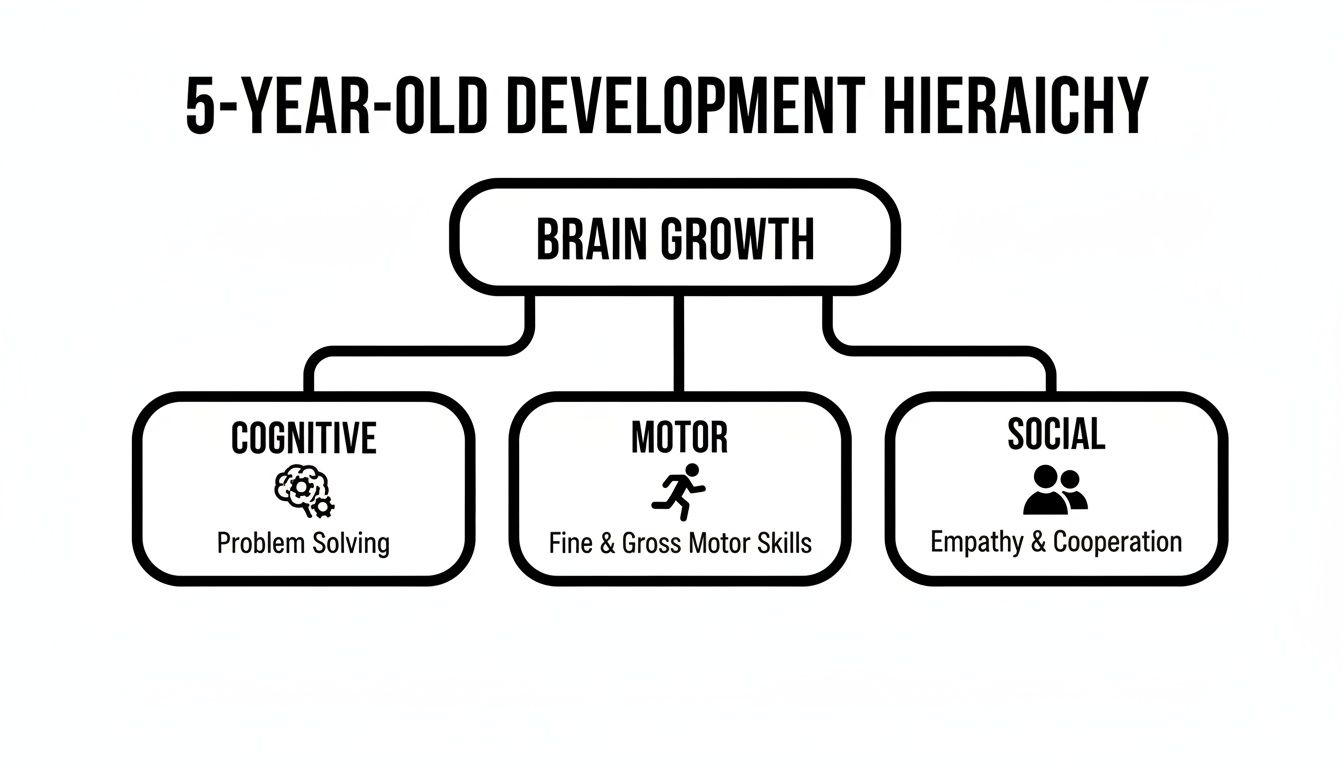
It’s a great reminder that when we support one area, we're actually strengthening the entire foundation for learning.
Fueling the Future Innovator with STEM Toys
STEM (Science, Technology, Engineering, and Math) toys are the perfect playground for a curious five-year-old. At this age, kids are natural scientists—they're always asking "why?" and running little experiments to figure out how things work. STEM toys give them the tools to discover the answers on their own.
We’re not talking about complex robotics or calculus here. It’s all about the basics. A good set of building blocks becomes an impromptu lesson in physics and balance. A simple coding toy teaches cause-and-effect without a single screen in sight.
Here’s what these toys really deliver:
- Logical Reasoning: They get kids thinking ahead, planning their moves, and seeing how one action leads to another.
- Problem-Solving Skills: When a tower wobbles or a marble run gets jammed, your child learns to troubleshoot, adapt, and try again. It's resilience in action.
- Spatial Awareness: Figuring out how blocks fit together or how gears turn builds a powerful, intuitive sense of shape, size, and space.
Construction sets are a fantastic starting point. If you're looking for ideas, it's worth checking out guides on the best construction toys for 5-year-olds to find sets that challenge them just the right amount.
Weaving Words with Literacy and Language Toys
A five-year-old's vocabulary is absolutely exploding! They're moving past simple phrases and into the world of detailed stories and big ideas. Toys in this category turn the journey toward reading and writing into an exciting game instead of a chore.
Think of interactive books that prompt them with questions, alphabet puzzles that connect a letter's look to its sound, or even a simple puppet theater. These tools empower kids to see language as something they can play with and control.
The best literacy toys are the ones that spark a conversation. They create a natural back-and-forth where you and your child can talk, imagine, and explore new words together. That’s how vocabulary and comprehension really take root.
Unleashing Creativity with Arts and Crafts
Art is so much more than making a colorful mess (though that’s definitely part of the fun). For a five-year-old, a fresh box of crayons, a lump of modeling clay, or a set of paints are vital tools for self-expression and motor skill development.
When they carefully snip paper with safety scissors or roll a piece of clay into a long snake, they are strengthening the exact hand and finger muscles they'll need for writing letters and numbers. It's pre-writing practice in its most joyful, engaging form.
Building Confidence with Gross Motor and Outdoor Toys
While we often focus on those tiny hand movements, a five-year-old’s whole body is craving big, active play. Gross motor toys are all about building coordination, balance, and the physical confidence that comes from mastering a new skill.
Look beyond the basic playground ball and consider toys that challenge them in new ways:
- Balance Bikes: They teach the tricky part of riding a bike—balancing—without the added confusion of pedals.
- Indoor Obstacle Courses: Use pillows, tunnels, and climbers to encourage full-body coordination and creative problem-solving on a rainy day.
- Scooters: These are perfect for learning to steer, judge distances, and control their speed.
This kind of play doesn't just build strong bodies. It builds resilient kids who aren't afraid to try something new, take a tumble, and get right back up to try again.
Nurturing Empathy Through Imaginative Play
Pretend play is where a five-year-old processes their world. It’s their laboratory for understanding complex social rules and emotions. A play kitchen, a doctor's kit, or a box of dress-up clothes are more than just props—they are invitations to walk in someone else’s shoes.
When kids "cook" a meal for a friend or play "family," they are practicing real-world skills like negotiation, sharing, and listening. They learn to blend their ideas with someone else's, building the social and emotional intelligence they’ll carry with them into the classroom and beyond.
To give you a quick cheat sheet, here’s how some of these popular toy categories connect directly to specific learning goals.
Matching Toy Categories to Learning Goals
This table provides a quick reference guide connecting popular toy categories with the primary developmental skills they support for a 5-year-old.
| Toy Category | Primary Learning Goal | Example Toy |
|---|---|---|
| STEM & Construction | Problem-Solving, Spatial Awareness | LEGOs, Magna-Tiles, Marble Runs |
| Literacy & Language | Vocabulary, Pre-Reading Skills | Interactive Books, Alphabet Puzzles |
| Arts & Crafts | Fine Motor Skills, Self-Expression | Modeling Clay, Safety Scissors, Paint |
| Gross Motor & Outdoor | Balance, Coordination, Confidence | Balance Bike, Scooter, Climbing Dome |
| Imaginative Play | Social Skills, Empathy, Storytelling | Play Kitchen, Doctor Kit, Puppets |
Think of this as a starting point. The best "play diet" includes a little something from each category to keep your child engaged, challenged, and growing in every way.
How to Choose Toys That Actually Get Played With
Walking down the toy aisle can be completely overwhelming. Every box shouts promises of being your child's new favorite, but we all know the reality: some toys are instant hits, while others are destined to collect dust in a corner. The trick isn't finding the flashiest gadget, but the toy that invites your child back to play again and again.
So, how do you spot the winners? It comes down to having a simple mental checklist. By looking at a few key factors before you buy, you can cut through the marketing noise and choose toys that are genuinely safe, engaging, and worth the money.
Prioritize Safety and Durability First
Before a toy can spark imagination or teach a new skill, it has to be safe. For an active five-year-old, this means sturdy construction and a design that's truly age-appropriate. Keep an eye out for small parts that could be choking hazards, any sharp edges, or flimsy materials that clearly won't survive enthusiastic play.
A well-made toy isn't just safer—it’s a better investment. Quality materials like solid wood or thick, non-toxic plastics are built to last. This focus on quality is a huge deal for parents. In fact, North America's major share of the global educational toys market, valued at USD 66.22 billion, is partly driven by this preference for durable, high-quality items. You can learn more about these educational toy trends and see just how much safety shapes what we buy.
Follow Your Child's Unique Interests
Here’s the simple truth: the most educational toy in the world is useless if your kid won’t touch it. The real secret to engagement is to lean into their current passions. If your five-year-old is completely obsessed with dinosaurs right now, a set of realistic dino figures will spark far more learning than a top-rated STEM kit that they have zero interest in.
Pay close attention to what grabs their attention day-to-day:
- Are they always building? Look for more advanced construction sets or magnetic tiles.
- Do they love making up stories? A puppet theater or a box of dress-up clothes could be a game-changer.
- Are they fascinated by nature? Think about a bug-catching kit or a simple kid-friendly gardening set.
When a toy connects with a child's natural curiosity, learning just happens. It’s effortless.
Look for Play Longevity and Growth Potential
Some toys are one-hit wonders. They're designed for a single trick that a child masters quickly and then gets bored with. The best toys, on the other hand, are the ones that can grow with your child. Think of it as the difference between a novelty gadget and a versatile tool.
A classic set of wooden blocks is the perfect example. A toddler might just stack them up and knock them down. But a five-year-old can use those very same blocks to build elaborate castles, map out a city, and even start exploring early math concepts like counting and balance. That kind of versatility is what makes a toy a truly great investment.
A truly valuable toy is one that meets your child where they are but also offers new challenges as they grow. It adapts to their developing skills, ensuring it remains a favorite for years, not just weeks.
Choose Open-Ended Potential Over Single Functions
This leads to one of the most important ideas in child development: open-ended toys. These are the unsung heroes of the playroom—toys that can be used in countless different ways, powered entirely by your child's imagination instead of batteries. They don't have a "right way" to be played with or a predetermined outcome.
Think about a talking robot that recites the alphabet versus a simple set of animal figurines. The robot does one thing. But those figurines? They can be characters in a wild jungle adventure, members of a farm family, or even curious visitors from another planet. Your child is the director, the storyteller, the creator.
Here's why open-ended toys are so incredibly powerful:
- They Foster Creativity: With no rules to follow, kids are free to invent their own worlds and stories.
- They Build Problem-Solving Skills: Kids have to figure out how to bring their imaginative ideas to life using the tools they have.
- They Encourage Independence: They empower children to lead their own play without needing adult instructions.
Keep an eye out for things like play dough, art supplies, magnetic tiles, and dress-up clothes. These simple items provide a blank canvas for your five-year-old's incredible imagination to run wild.
Unlocking Your Child's Imagination Through Guided Play
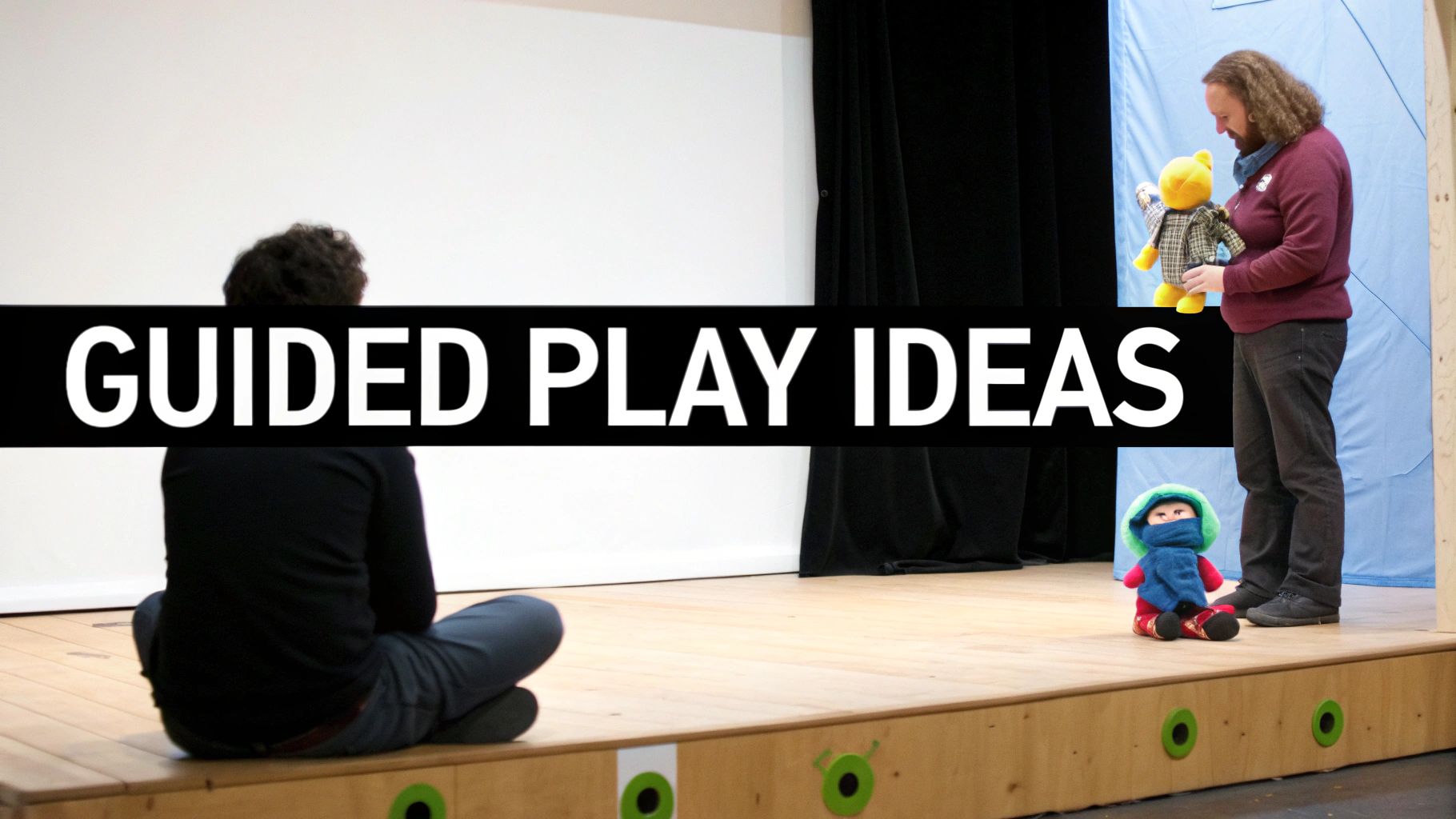
Even the absolute best educational toys for 5 year olds are just pieces of plastic or wood until a child’s imagination sparks them to life. While we all love when our kids play independently, getting involved in what’s called “guided play” is where you can really unlock a toy’s learning power.
This doesn't mean taking over or directing their every move. Far from it. It's about joining your child in their world for a few minutes to ask good questions, float new ideas, and build connections together. Think of yourself as a co-pilot, not the pilot. Your job is just to offer gentle prompts that open up new ways to explore, turning a simple play session into a memorable learning adventure.
Simple Prompts For Big Learning
The secret to guided play is that it should be low-effort but high-impact. You don't need complicated plans or scripts. A few thoughtful questions are often all it takes to stretch your child's thinking and sneak in concepts like problem-solving, storytelling, and curiosity.
Here are a few easy ways to get started with different kinds of toys:
-
Building Block Blueprints: With blocks like LEGOs or Magna-Tiles, try setting up a fun challenge. Something like, "Can we build a bridge strong enough to hold this toy car?" or "Let's see who can build the tallest tower using only the red blocks!" This simple twist shifts the focus from just stacking to actual engineering and thinking about space.
-
Puppet Show Story Starters: Grab a couple of puppets or even stuffed animals and kick off a story. You could start with, "Once upon a time, this brave lion was searching for his friend, the silly monkey. Where do you think he should look first?" This one little prompt invites your child to jump in and co-create the story, which is fantastic for their creativity and early literacy skills.
-
Kitchen Chemistry Experiments: A play kitchen makes a perfect little lab for easy science. Ask questions like, "What do you think will happen if we 'mix' the pretend eggs and flour together?" or "Let's sort all our play food by color before we 'cook' dinner." These activities introduce basic ideas like sequencing and sorting in a really fun, natural way.
Guided play is less about teaching and more about wondering together. When you ask "I wonder what would happen if..." you give your child permission to experiment, make mistakes, and discover things on their own.
Fostering Deeper Connections
Beyond all the academic benefits, these shared moments are pure gold for your child's social and emotional growth. When you get down on the floor and engage with their play, you're sending a powerful message: "What you're doing is important, and I'm interested." That validation is a huge confidence-booster and strengthens your bond.
To take it a step further, you can use playtime to build empathy and emotional understanding. Bringing emotional intelligence games for kids into your guided play is a wonderful way to help them put names to their feelings and see things from another's point of view.
For example, you could use dolls to act out a scene where one feels left out. Then ask your child, "How do you think she feels? What could we do to help her feel better?" This transforms playtime into a safe space for developing some of the most crucial skills they'll ever learn.
Keeping Your Toy Collection Fresh and Engaging
You’ve invested time and money into building a fantastic collection of educational toys. But what happens when that amazing collection turns into a chaotic mess piled in a corner? The magic quickly disappears.
The secret to keeping those toys powerful learning tools is to treat them less like clutter and more like a curated library. A little organization and care can make all the difference, keeping your child’s curiosity alive and maximizing your investment. The goal isn't just a tidy room—it's creating a space that truly invites your child to explore.
A cluttered, overwhelming play area can actually short-circuit a five-year-old’s ability to focus. When too many options are available, it's hard to engage deeply with any single one. A simple, organized setup, on the other hand, is a calm invitation to come and play.
The Power of Toy Rotation
One of the most effective strategies I recommend to parents is toy rotation. It’s brilliantly simple. Instead of having every toy out all the time, keep a smaller, curated selection accessible and store the rest away.
Every few weeks, swap them out. You'll be amazed at how this makes old toys feel completely new again.
This system works wonders for a few reasons:
- It cuts down on overwhelm. With fewer choices, kids can dive deeper into more focused, imaginative play.
- It sparks renewed interest. The novelty of seeing a "forgotten" toy reappear is genuinely exciting for them.
- It makes cleanup a breeze. Less stuff out means tidying up is a much less daunting task for a five-year-old.
I like to think of toy rotation as curating a mini-exhibit in your own home. You're thoughtfully highlighting specific items to be explored, preventing them from getting lost in a sea of stuff. It’s a method that respects both the toys and your child’s developing mind.
Maintaining Your Investment
Just like any other valuable tool, toys last longer with proper care. A quick wipe-down or wash extends their life and keeps them safe for play. Always check the manufacturer's instructions first, but here are a few good rules of thumb:
- Wooden Toys: A simple wipe with a damp cloth and a mild soap or vinegar solution does the trick. Try to avoid soaking them completely, as it can cause the wood to swell and warp.
- Plastic Toys: Most hard plastic toys are easy. You can wash them in a sink of warm, soapy water or even place them on the top rack of the dishwasher for a deep clean.
- Stuffed Animals: Check the care tag. Many plush toys are surprisingly machine washable—just use a gentle cycle and let them air dry.
By building these simple habits, you're not just managing a pile of toys; you're maintaining a dynamic collection of learning resources. This ensures your educational toys for 5 year olds will continue to support their incredible journey of discovery for a long time to come.
Still Have Questions? Let's Clear Things Up
Even after you've done your homework, it’s completely normal to have a few questions rattling around. The world of educational toys for 5-year-olds can feel overwhelming, but a few straightforward answers can help you feel confident you're making the right call for your child.
Here are some of the most common questions I hear from parents, broken down with some practical advice.
How Many Toys Does My 5-Year-Old Actually Need?
This is the big one, and my answer is almost always the same: fewer than you think. Seriously. The real magic happens with quality, not quantity. A child with a handful of versatile, open-ended toys will almost always engage in deeper, more imaginative play than a child with a room buried in single-use gadgets.
When there are too many choices, kids get overwhelmed. They tend to flit from one thing to the next, never really settling into that deep, meaningful play we want to see. A smaller, well-chosen collection encourages them to focus, get creative, and really appreciate the toys they have.
True learning happens when a child explores every possibility a single toy has to offer, not when they're surrounded by dozens of distractions. Aim for a manageable set of high-quality, flexible toys instead of a mountain of things that will be forgotten tomorrow.
Are Screen-Based "Learning Toys" as Good as Physical Ones?
Digital learning tools definitely have a place. There are some fantastic apps and games out there that are great for drilling specific skills, like letter sounds or simple addition. But they aren't a direct substitute for old-school, hands-on toys.
Physical toys deliver crucial benefits that screens just can't match:
- Hands-On Learning: The feeling of stacking blocks until they tumble or squishing dough between their fingers builds essential sensory and fine motor skills.
- Real Social Skills: Traditional toys are the natural hub for playing together. It’s where kids learn to share, take turns, negotiate, and figure out what their friends are thinking.
- Unlimited Imagination: A set of blocks is powered entirely by your child's brain, not by a pre-written program. This is where true, out-of-the-box creative thinking is born.
The best approach is usually a balanced one. Think of screen time as a focused workout for specific skills, but prioritize hands-on, open-ended toys for building that core foundation of creativity, social skills, and physical development.
How Do I Introduce a New Toy to Get Them Excited?
The way you present a new toy can make all the difference. Don't just hand over the box and walk away. Try to create a little moment around it. Get down on the floor, open it together, and show that you're just as curious as they are.
You could say something like, "Whoa, look at all these pieces! I wonder what we could build with this?" That simple act of shared discovery makes it an invitation, not a test. It removes any pressure to "do it right." Spend a few minutes exploring alongside them to get things started, and then let them take the reins.
How Can I Tell if a Toy is Genuinely Educational?
Toy marketing can be tricky—everything is labeled "educational" these days. To cut through the hype, just ask yourself these four simple questions before you buy:
- Is it open-ended? Can my child use this in a bunch of different ways, or does it only do one thing?
- Is my child active or passive? Does the toy do all the work, or does my child have to use their brain and body to make the fun happen?
- Will it last? Can I picture them still playing with this in six months or a year from now, even if they play with it differently?
- Does it bring people together? Is this a toy that works well for playing with siblings, friends, or me?
If the answers point toward creativity, active thinking, and staying power, you’ve probably found a winner.
At Learning Through Play, we believe the right toys can spark a lifelong love of learning. Explore our curated collection to find the perfect tools to inspire your child's curiosity and growth. Find your next great toy at https://admin.shopify.com/store/learningthoughtplay.