
The best toys for language development? You might be surprised to hear they’re often the simplest ones. Think classic blocks, dolls, and a basket of play food. These open-ended toys are conversation starters, creating space for the rich, interactive back-and-forth that builds vocabulary far better than toys that just talk or make sounds on their own.
How Playtime Powers Language Growth
Have you ever watched a toddler with a set of wooden blocks and wondered how that simple activity connects to talking? The link between play and speech is powerful, but the magic isn't in a toy's batteries or buttons. The best toys don’t talk at your child; they give your child a reason to talk with you.
A great toy is really just a prop on a stage. You and your child are the lead actors, and together you create stories, solve problems, and discover new words. The real learning doesn't come from the toy itself, but from the shared experience it sparks. That’s where language truly blossoms.
The Power of Shared Attention
Before a child can say "ball," they first have to look at the ball with you. This is called joint attention, and it's one of the earliest and most important building blocks for communication. When you both point to the same toy cow and talk about it, you’re creating a shared moment.
That simple act of focusing together shows your child that the sounds you're making ("Moo! Look at the cow!") are directly connected to the object they're holding. It turns a plastic figure into a real concept with a name. Toys that naturally draw you and your child to focus on the same thing are absolute gold for developing early language skills.
The real value of a toy isn't measured in features, but in the number of conversations it starts. A silent set of blocks that sparks a 20-minute chat about building a "big, tall tower" does more for language than a noisy gadget that keeps a child occupied in silence.
From Objects to Ideas
As kids get a little older, their play gets more interesting. It moves beyond just handling objects and into the world of symbolic thinking. Suddenly, a banana is a telephone, a cardboard box is a spaceship, and a teddy bear is a patient with a tummy ache. This kind of pretend play is a serious workout for their language brain.
It pushes them to:
- Use descriptive words: "The bear has a sore tummy."
- Practice social conversations: "Hello, doctor. Can you help him, please?"
- Understand storytelling: "Okay, first we check his temperature. Then, we give him the medicine."
This leap from the concrete to the abstract is crucial for developing more complex language and the ability to tell stories. It’s no surprise that studies confirm interactive play—the kind that gets parents and kids talking—leads to significant vocabulary growth compared to toys that kids just watch or listen to passively. You can learn more by checking out the research on educational toy effectiveness.
At the end of the day, choosing the best toys for language development is all about prioritizing connection over complexity. Every playtime is a chance for communication to take flight.
Choosing the Right Toys for Every Age and Stage
You wouldn't give a steak to a newborn, right? The same logic applies to toys. The very best toys for language development are the ones that meet a child exactly where they are, offering just enough of a challenge to nudge them toward the next milestone. Matching toys to your child's developmental stage is the secret to turning simple playtime into a powerful engine for communication.
To do this well, it helps to have a good sense of the key child language development stages. When you understand what’s happening in your child's brain, you'll start to see the toys on their shelf in a whole new light, making you a much more effective play partner.
Language-Boosting Toys by Age and Developmental Stage
To make this easier, here’s a quick-reference table that connects age ranges with the language skills your child is working on and the kinds of toys that can help the most.
| Age Range | Key Language Milestones | Recommended Toy Categories |
|---|---|---|
| Birth–12 Months | Responding to sounds, cooing/babbling, making eye contact, joint attention. | Sensory toys, soft books, puppets, baby-safe mirrors, rattles. |
| 1–2 Years | Saying first words, naming familiar objects, following simple commands. | Chunky puzzles, stacking rings, simple blocks, toy vehicles and figures. |
| 2–3 Years | Vocabulary explosion, using 2-3 word phrases, starting pretend play. | Toy kitchens/food, baby dolls, more advanced building blocks. |
| 3–5 Years | Telling stories, asking complex questions, engaging in cooperative play. | Detailed pretend play sets (doctor, vet), dress-up clothes, alphabet toys. |
This table is a great starting point, but let’s dig a little deeper into what makes these toys so effective at each specific phase of your child's growth.
Birth to 12 Months: The Sensory Explorers
In that first year, a baby's world is a beautiful whirlwind of new sights, sounds, and textures. Language isn't about words just yet; it's about building the all-important foundation for communication. Think eye contact, babbling, responding to your voice, and that magical moment of "joint attention"—when you're both looking at the same thing.
The best toys for this stage are simple and sensory-rich, inviting interaction without overwhelming their brand-new nervous system.
- Soft Books and Puppets: These are perfect for cuddling up close and making silly, exaggerated sounds. A puppet can "talk" to your baby, encouraging those first coos and babbles in response.
- Mirrors: A simple, unbreakable mirror is a fantastic tool for self-discovery. As you point to their reflection and say, "Look at that baby!" you’re building facial recognition and teaching the back-and-forth rhythm of conversation.
- Rattles and Shakers: These toys teach a critical lesson in cause and effect. When a baby shakes a rattle and it makes a noise, they learn their actions can create a response—a core principle of all communication.
This progression is simple but incredibly powerful: the toy creates a reason to interact, and that interaction sparks language.
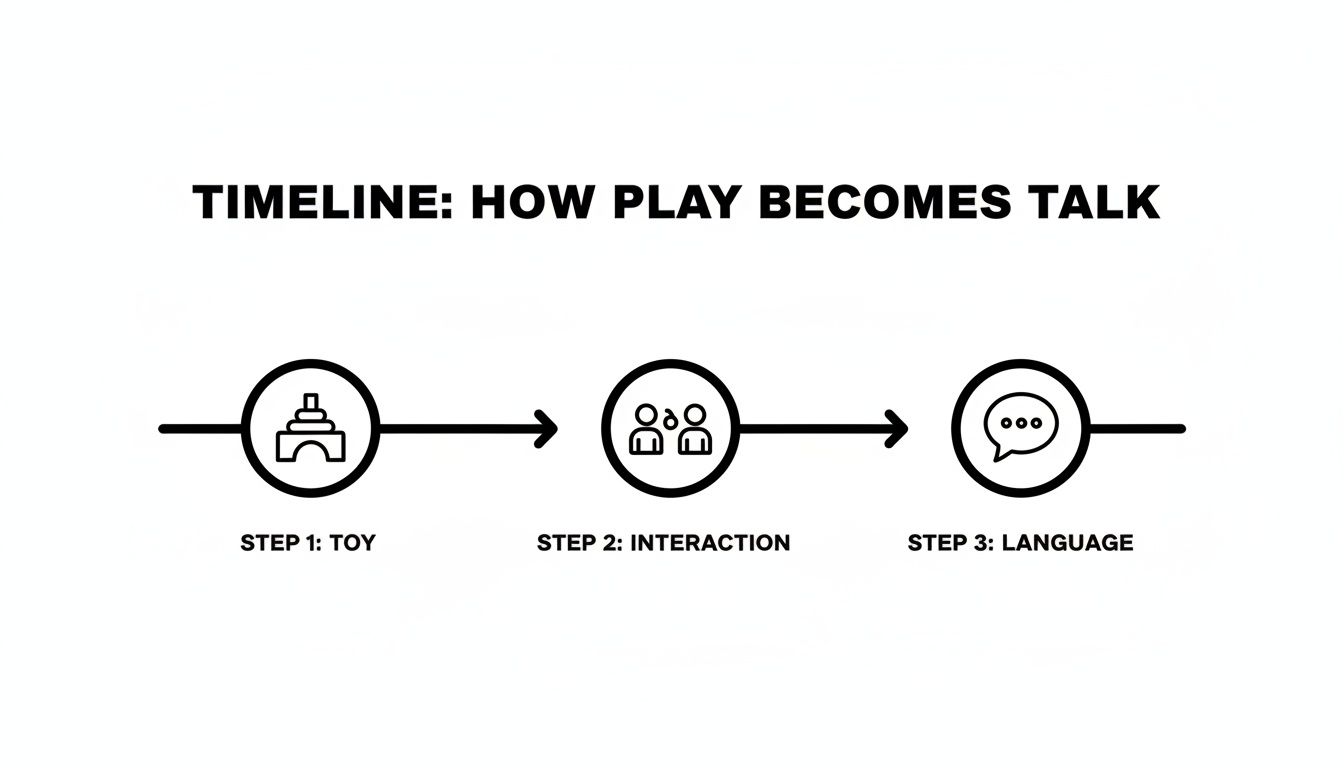
The toy itself is just the starting point. The real magic happens in the shared moments it creates between you and your child.
One to Two Years: The First Words Emerge
Get ready for some serious growth! Toddlers are on the move, endlessly curious, and often starting to say their very first words. Their play becomes more purposeful as they begin to understand simple requests and the names of things around them.
Your goal now is to choose toys that give you endless opportunities to label objects and describe actions.
- Chunky Puzzles: Simple puzzles with big knobs and familiar shapes (like animals or vehicles) are perfect. Each piece is a chance to name something ("That's the cow!") and practice sounds ("The cow says moo!").
- Stacking Rings and Blocks: Building a tower just to knock it down is more than just fun. It’s a hands-on lesson in action words like "up, up, up," "on top," and "all fall down!" It also introduces concepts like size and order without them even realizing it.
- Toy Vehicles and Figures: Cars, trucks, and little animal figures are fantastic for connecting words to actions. Pushing a car while saying "Vroom!" or making an elephant "stomp, stomp, stomp" helps build those crucial brain connections.
Your role at this stage is to be your child’s narrator. The more you describe what they see and do—"You put the red block on the blue block!"—the faster their brain will link objects, actions, and words together.
Two to Three Years: The Language Explosion
Welcome to the age of "Why?" Toddlers at this stage are soaking up new words like sponges and starting to string two or three of them together into little sentences. Their play is also becoming much more imaginative as they begin to imitate the world around them.
This is when the best toys are the ones that support this budding creativity and the beginnings of true pretend play, where a block can suddenly become a telephone.
- Toy Kitchens and Play Food: A toy kitchen is basically a language laboratory. It creates a natural setting to learn verbs (cut, stir, pour), nouns (apple, spoon, cup), and simple social scripts ("More soup, please!").
- Baby Dolls and Accessories: Caring for a baby doll encourages nurturing play and introduces a ton of vocabulary related to body parts, clothing, and daily routines like eating, bathing, and sleeping.
- Basic Building Blocks: As their fine motor skills improve, they can build more complex structures. This is a great way to introduce spatial language (next to, under, behind) and even early problem-solving ("How can we make a bridge?").
Three to Five Years: The Master Storytellers
Preschoolers are turning into sophisticated little communicators. They can tell simple stories, ask surprisingly complex questions, and engage in detailed, cooperative play with their friends. Their play scenarios become elaborate, complete with characters, plots, and a lot of rule negotiation!
The right toys for this age fuel that advanced imaginative play while also sneaking in some early literacy concepts.
- Pretend Play Sets: A doctor's kit, vet clinic, or little grocery store provides all the props needed for rich, detailed storytelling. Kids get to practice taking on different roles and using complex sentences to explain their ideas.
- Dress-Up Clothes: Something magical happens when a child puts on a cape or a firefighter's hat. They become someone else entirely, which encourages them to use different tones of voice and explore all the new words that go with that character.
- Alphabet Toys and Puzzles: As they get closer to school, toys that make letters and sounds fun are invaluable. Magnet letters on the fridge, alphabet puzzles, and letter blocks turn pre-reading skills into a hands-on game.
It’s not just a hunch—the research backs this up. Studies show that children who regularly engage in pretend play demonstrate 15–25% higher scores on storytelling and sentence complexity. Similarly, those who play with alphabet toys often score 10–20 percentile points higher on early literacy tests when they start school. By thoughtfully choosing age-appropriate toys, you’re not just buying them something fun; you're laying a solid foundation for both conversation and future academic success.
The Power of Pretend Play for Building Narrative Skills
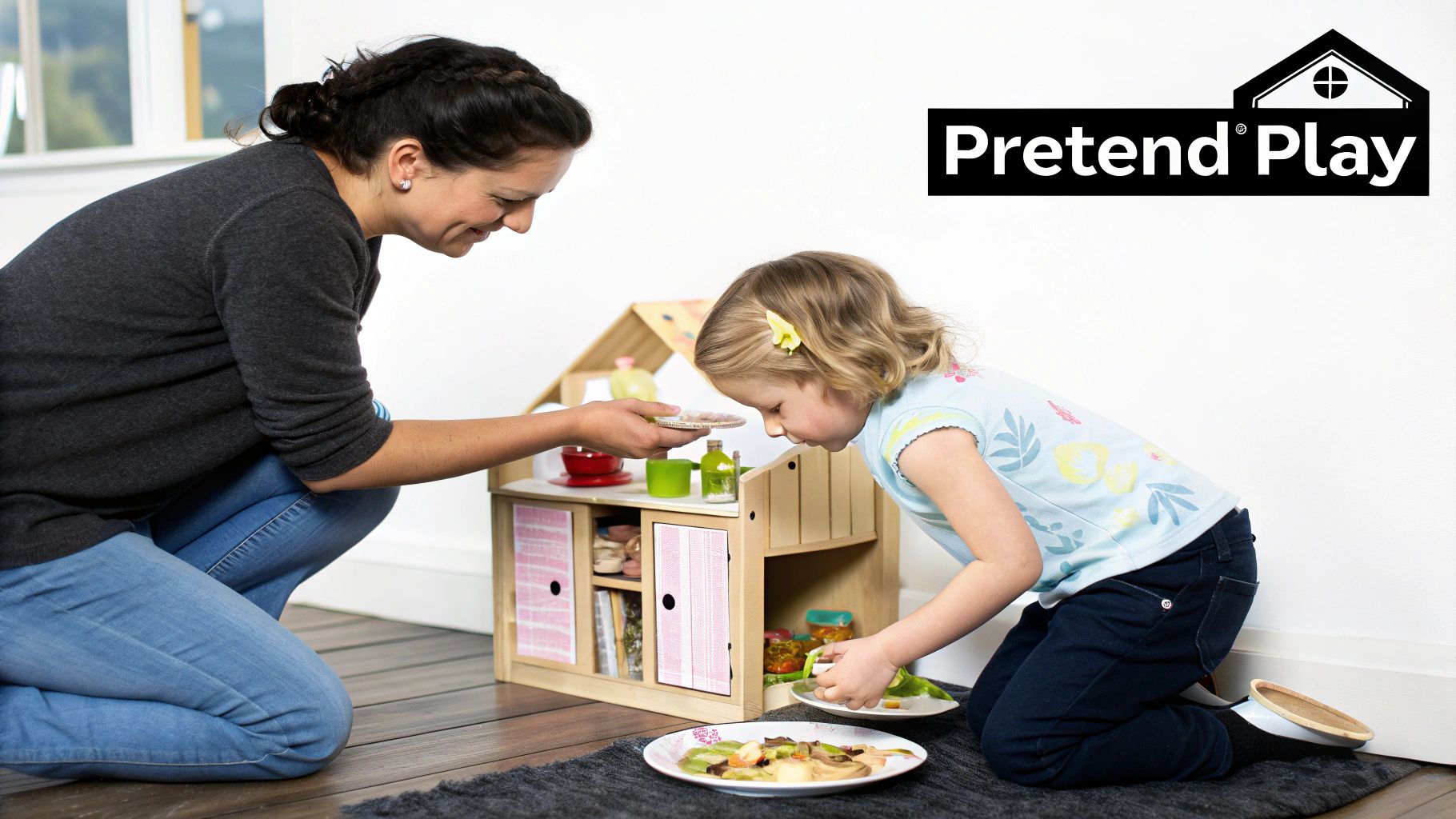
As toddlers blossom into preschoolers, you'll witness a magical shift in their play. A simple toy kitchen or a doctor’s kit is no longer just a pile of plastic pieces; it’s a bustling restaurant or a busy emergency room. This is pretend play, and it's one of the most powerful ways children build advanced language skills.
When a child dives into an imaginary world, they're really practicing how to be a storyteller. They stop just reacting to the world around them and start creating their own. That imaginative leap is a huge milestone for communication.
From Simple Actions to Complex Stories
Think about how a child plays with a dollhouse. At first, the actions are pretty straightforward. They might put a doll in the bed and say, "Night-night." But stick with it, and you'll see that simple act evolve into a whole narrative with a real structure.
Soon, the doll isn't just sleeping. She had a long day at the park, ate her dinner, brushed her teeth, listened to a bedtime story, and then went to sleep. This progression shows that your child is grasping narrative structure—the idea that stories need a beginning, a middle, and an end.
This is the very same skill they’ll use later to tell you about their day at school, follow the plot of a book, or write a story. Pretend play is their first rehearsal for a lifetime of storytelling.
Pretend play is like a language gym. Every imaginary scenario is a chance for a child to flex their vocabulary, practice sentence structure, and build the endurance needed for complex conversations.
By acting out these scenes, kids naturally start using more sophisticated language. Making a toy car "drive" to the store and then "come back" home gives them a hands-on way to practice verb tenses and directional words. It just clicks.
Building Social Communication Skills
Pretend play rarely stays a solo activity for long. The moment another child or a parent joins in, the language gets a lot more complex. A simple doctor's visit scenario suddenly becomes a masterclass in social communication.
To make it work, kids have to navigate a whole host of verbal skills:
- Negotiating Roles: Figuring out "You be the doctor, and I'll be the patient" requires clear communication and agreement.
- Problem-Solving: When the teddy bear patient has a "sore tummy," the players have to talk about the problem and decide on a solution, like giving pretend medicine.
- Taking Turns: The conversation flows back and forth, reinforcing the natural rhythm of a real dialogue.
These interactions are crucial for developing what speech-language pathologists call pragmatics—the unwritten social rules of language. Learning to listen, respond in a way that makes sense, and see a situation from someone else's point of view are all skills that get a great workout during a good session of pretend play.
How to Guide and Maximize the Learning
Your role here is to be a supportive co-star, not the director of the show. The goal is to gently nudge the story along and introduce new words and ideas without taking over the fun.
Here are a few easy strategies you can use with any pretend play setup:
- Introduce a "Problem": Create a simple, low-stakes conflict for the characters to solve. While playing with a toy kitchen, you could say, "Oh no! We're all out of milk for the cake. What should we do?" This encourages your child to use language for planning and problem-solving.
- Model More Complex Sentences: If your child says, "Doggy sick," you can build on that. Respond with something like, "Yes, the poor doggy is sick. I think we need to take him to the vet right away." You're showing them how to expand their own ideas.
- Ask Open-Ended Questions: Steer clear of questions with a simple "yes" or "no" answer. Instead of, "Is the baby hungry?" try asking, "What should we make the baby for lunch?" This invites a much more detailed and creative response.
By jumping in with these small prompts, you can turn a simple playset into a dynamic workshop for building complex language. The best toys for language development, especially in these preschool years, are the ones that act as a blank canvas, giving your child the freedom to paint their own stories with words.
Your Playtime Toolkit for Boosting Conversation
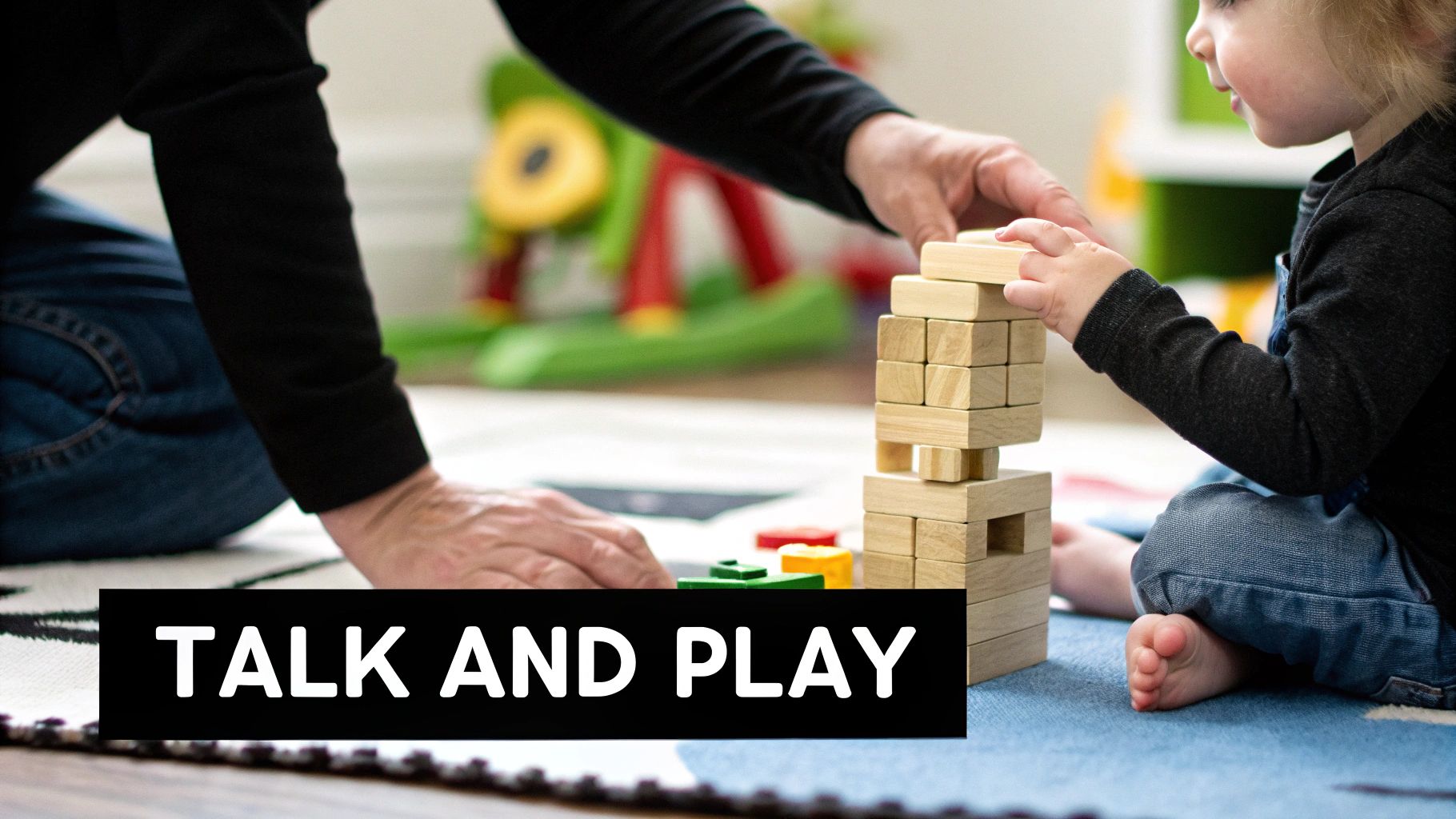
Having a shelf full of wonderful, open-ended toys is the perfect starting point. But the secret to unlocking their language-building power isn't in the toys themselves—it's in how you play with them. Your role is to become a conversation architect, using every moment as a chance to build a richer vocabulary and stronger communication skills.
Think of yourself as your child’s playful narrator. With just a few simple strategies, you can turn a basic block or a toy animal into a dynamic tool for conversation. This toolkit will give you some practical techniques to make every play session a language-rich experience.
Model Language Like a Pro
One of the most powerful things you can do is simply talk about what’s happening around you. Known as self-talk and parallel talk, this provides a steady stream of language that connects directly to what your child is seeing and doing. It’s like being a sportscaster for their world.
- Self-Talk: This is when you narrate your own actions. For instance, while playing with blocks, you might say, "I am getting a big red block. I'm putting the red block on top."
- Parallel Talk: Here, you narrate your child's actions. As you watch them, you could say, "You are pushing the blue car. Look at it go! The car is going so fast!"
This approach is brilliant because it doesn't demand a response from your child. It just immerses them in language that’s relevant and happening in real-time, helping their brain forge strong links between words and actions.
Your goal isn't to quiz your child. It's to create a 'language bath' where they can soak up new words, sentence structures, and the natural back-and-forth of conversation. The learning happens through listening long before they can say the words themselves.
Expand on Their Ideas
When your child starts using words, your response can either end the conversation or keep it going. The key is to use expansions—taking what your child says and gently building it into a more complete, grammatically correct sentence. This validates their effort while modeling the next step in language.
If your child points and says, "Car go," you can expand on that by saying, "Yes, the blue car is going down the ramp!" You've acknowledged their thought, added descriptive words (blue), and used a more complex sentence.
Here’s how this works with different toys:
| If Your Child Says... | You Can Expand It To... | Toy Example |
|---|---|---|
| "Baby eat." | "The baby is eating the yummy apple." | Baby doll & play food |
| "Cow moo." | "That's right, the big brown cow says moo!" | Farm animal set |
| "Block up." | "You are putting the green block up on the tower." | Building blocks |
This simple act of recasting their words shows them you're listening and gives them a blueprint for building bigger, more descriptive sentences on their own.
Ask Meaningful Questions
Questions are a fantastic way to encourage talking, but not all questions are created equal. Closed-ended questions that only need a "yes," "no," or a single word are fine, but open-ended questions are where the real magic is. These questions invite imagination, storytelling, and more complex thinking.
Instead of asking, "Is the pig muddy?" (which gets a simple "yes"), try asking something like, "Why do you think the pig is playing in the mud?" This kind of question has no single right answer, nudging your child to think creatively and explain their ideas.
Here are a few open-ended question starters to keep in your back pocket:
- "What do you think will happen next?"
- "Hmm, how can we solve this problem?"
- "Tell me more about what the dolly is doing."
- "Oh no! Why did the car crash?"
When you have these simple but powerful techniques ready, you can turn everyday playtime into a fun, engaging, and incredibly effective language lesson. Suddenly, any toy can become one of the best tools for development.
What to Look For When Buying Language Development Toys
Walking down the toy aisle can feel like a sensory assault. Bright colors, flashing lights, and bold claims about educational benefits are everywhere. So, how do you actually pick a toy that will help your child learn to talk? The secret is to change your perspective. Stop asking, "What does this toy do?" and start asking, "What can my child and I do with this toy?"
The best toys for language are often the simplest ones. They’re like a blank canvas, inviting your child to take the lead. This creates the space for those back-and-forth interactions that are the bedrock of vocabulary and conversation. A noisy electronic gadget that dictates the rules can actually make a child go quiet, whereas a simple set of blocks can spark a whole conversation about building a castle for a king.
Prioritize Open-Ended Play
Look for toys that don’t have one "right" way to be used. We call these open-ended toys, and they are absolute powerhouses for sparking imagination and, with it, language.
- Blocks and Building Sets: One day they’re a house, the next a spaceship, and the day after that, a zoo. This kind of variety encourages kids to use descriptive words and tell stories.
- Play Dough or Art Supplies: These give your child a reason to talk about colors, shapes, and what they’re creating. "Look, I made a long green snake!"
- Animal or Character Figurines: These are the perfect props for acting out detailed stories and practicing the give-and-take of social conversations.
The beauty of these toys is that they grow with your child. A one-year-old might just stack a few blocks, but a four-year-old will use the exact same set to build an entire city, narrating every single step. For more ideas, check out Kubrio's ultimate learning gift guide for skill-building toys.
A toy's real worth isn't in its fancy features, but in its power to start a conversation. The more a toy does, the less your child has to do—and say. Aim for toys that are 90% child and 10% toy.
Evaluating Toy Quality and Safety
The educational toy market is massive—and still growing. With projections showing the industry hitting over $60 billion in 2024, there's an overwhelming number of options, but the quality can be all over the place. Choosing toys that are truly built for learning is key to making sure those market choices translate into real language gains for your child.
When you're out shopping, keep a few practical things in mind:
- Safety First: This is non-negotiable. Always check the age recommendations on the packaging. For little ones, make sure there are no small parts that could be a choking hazard and look for non-toxic materials.
- Durability Matters: A well-made toy will stand up to years of enthusiastic play. Wooden toys, for instance, often outlast their plastic counterparts and can be passed down from one child to the next.
- Battery-Free is Often Better: Toys that don’t need batteries are naturally more interactive. They’re powered by your child's imagination, which is the best engine there is for language growth.
Ultimately, picking the right toy comes down to connection. Look for things that make you want to get down on the floor and play with your child. It’s in those shared moments of play that the most meaningful language learning happens.
Of course. Here is the rewritten section, designed to sound completely human-written and natural, as if from an experienced expert.
Your Top Questions About Toys and Language
Even with the best advice in hand, it’s only natural to have questions pop up. Navigating the world of toys can feel overwhelming, and it's easy to second-guess yourself when you're trying to do what's best for your child's development. Let's tackle some of the most common questions I hear from parents.
Think of this as your personal FAQ. It’s here to clear up those nagging doubts, offer practical solutions for real-life play scenarios, and help you feel more confident in your choices. At the end of the day, it all comes back to a simple, powerful idea: focus on connection and follow your child's lead.
Are Electronic Toys Really That Bad for Language?
This is a big one, and the answer isn't a simple "yes" or "no." The real problem with many electronic toys is that they do all the talking. When a toy sings, counts, and makes all the noises on its own, your child can easily slip into a passive mode—just watching and listening. That’s the exact opposite of the active engagement that actually builds language.
But not all tech is a problem. The trick is to ask yourself one question: Does this toy invite me to play with my child? A tablet app where you can build a story together, for instance, is a world away from a plastic phone that just spouts pre-recorded phrases.
The issue isn’t the battery; it’s the missed opportunity for a conversation. If an electronic toy can start a conversation instead of ending one, it might be a keeper. A great rule of thumb is to look for toys that are 90% child and 10% toy.
Take an electronic keyboard. If you use it to talk about making loud sounds versus quiet sounds together, it’s a wonderful tool for interaction. But a toy that just plays a song when you push a button doesn't leave much room for your child to add their own ideas. Always lean toward toys that need your child’s imagination to truly come to life.
What if My Child Just Ignores a New Toy?
It can be so frustrating to pick out what you think is the perfect toy, only to have your child give it a quick glance and walk away. Before you write it off as a failure, take a breath. Kids are often hesitant about new things and sometimes just don't see the play potential right away.
The best thing you can do is model the fun. Don't try to force it on them. Instead, get down on the floor and start playing with it yourself. Talk out loud while you do it. "Wow, these blocks are amazing! I'm going to build a really, really tall blue tower." Your authentic enthusiasm is the best invitation they could ask for.
Here are a few other things to try:
- Make it Available: Just leave the new toy in their regular play space, right next to their old favorites. This gives them a chance to discover it on their own terms, without any pressure.
- Bridge the Gap: If they're obsessed with cars, use those new building blocks to make a garage or a bridge for their favorite truck. Connecting the new to the familiar makes it much more appealing.
- Give It Time: Seriously, sometimes the timing just isn't right. A child who couldn't care less about a shape sorter at 15 months might suddenly be completely fascinated by it at 18 months. Their skills just needed to catch up to the challenge.
How Should I Adapt Play for a Child with a Language Delay?
If your child has a language delay, the core principles of play don't just apply—they become even more critical. Your focus is still on connection and following their lead, but you'll want to be more intentional about creating opportunities for communication. The best toys are still the simple, open-ended ones that won't overwhelm them.
Your job as their play partner is to create a safe, supportive space where there's zero pressure to perform. Celebrate every single attempt to communicate, whether it’s a sound, a hand gesture, or a word. If you're working with a speech-language pathologist, be sure to ask how you can use their favorite toys at home to support the goals you're working on in therapy.
A simple ball, for example, is a powerhouse for language practice. You can work on:
- Requesting: Hold onto the ball and wait for them to look at you, make a sound, or sign to ask for it.
- Turn-Taking: Roll the ball back and forth to establish that natural, conversational rhythm of "my turn, your turn."
- Core Vocabulary: Repeat simple, powerful words like "go," "ball," "more," and "uh-oh!"
Remember, play is your child’s first language. When you meet them where they are and join them in their world, you create the most powerful environment for their communication skills to blossom. Your patient, playful presence is truly the best tool you have.
At Learning Through Play, we believe the right toys can open up a world of conversation. Explore our curated selection of toys designed to spark interaction and joy. Start your play journey with us today!