
The best toys for imaginative play? They're usually the simplest ones. Think of them as a blank canvas for your child's mind. Top choices are almost always versatile, open-ended items like wooden blocks, magnetic tiles, dress-up clothes, and animal figurines. Why? Because they put the child in the driver's seat, forcing them to do the creative heavy lifting that builds essential life skills.
The Power of Pretend: Why Imaginative Play Is So Important
When a child turns a cardboard box into a spaceship or a blanket fort into a king's castle, something incredible is happening. This isn't just killing time—it's the real work of childhood. Imaginative play is your child’s first gig as a director, storyteller, and problem-solver, all within a mental playground where they can safely rehearse for life.
Think of it as a workout for their developing brain. By acting out different scenarios, from being a chef in a play kitchen to an astronaut on Mars, kids are laying the foundation for skills they'll use forever. Finding the right toys isn't about the flashiest gadgets or the loudest sounds. It's about finding the keys that unlock a child's own boundless potential.
Building Life Skills, One Pretend Game at a Time
Imaginative play is a powerful engine for development, directly fueling a child's cognitive and emotional growth. It gives them a safe space to test out complex situations and see the world from new angles.
- Creative Problem-Solving: When a toy car gets "stuck" under the couch-canyon, there's no instruction manual. Your child has to invent a solution, test out ideas, and think on their feet. That's building mental flexibility in real-time.
- Emotional Intelligence: Role-playing games like "playing house" or "doctor" are exercises in empathy. They let children step into someone else's shoes, learning how to negotiate, share ideas, and manage feelings when little conflicts pop up.
- Language and Communication: Pretend play is a conversation factory. Kids create dialogue for their dolls, narrate epic adventures, and stretch their vocabulary to describe the incredible worlds they’ve dreamed up.
Imaginative play is the ultimate mental playground. It gives children a safe, low-stakes environment to try on different roles, navigate complex emotions, and solve make-believe challenges, effectively rehearsing for real life.
The Magic in Simple Things
I've always believed the most effective toys are 90% child and 10% toy. A plain wooden block doesn't tell a child what it is; it asks, "What can I become?" This active participation is where the real learning happens.
This idea—that a toy becomes 'real' through a child's love and imagination—is captured perfectly in classics like The Velveteen Rabbit. When you choose toys that invite this kind of open-ended interaction, you're not just giving them a thing to play with. You're supporting their natural curiosity and empowering them to be the creators of their own stories.
How to Choose Toys That Grow With Your Child
Knowing a toy is great is one thing, but matching it to your child’s specific developmental stage is where the real magic happens. A toy that sparks incredible stories for a five-year-old might just overwhelm a toddler. The best imaginative play toys meet kids exactly where they are, offering just enough challenge to keep them engaged without tipping over into frustration.
It’s a bit like buying a bicycle. If it's too big, they can’t reach the pedals and feel defeated. If it’s too small, it holds them back from new adventures. The goal is to find that perfect fit that feels both comfortable and exciting, giving them the confidence to grow.
To help you find that sweet spot, here’s a quick-reference guide matching developmental stages with the kinds of toys that really get their imaginations firing.
Imaginative Play Toy Ideas by Developmental Stage
| Developmental Stage | Play Focus | Example Toy Categories (Brand-Agnostic) |
|---|---|---|
| Toddlers (1–3 Years) | Imitation & Cause-and-Effect | Stacking blocks, play food, toy phones, simple puzzles, soft dolls, ride-on toys, child-sized cleaning tools. |
| Preschoolers (3–5 Years) | Storytelling & Social Play | Dress-up clothes, building sets (blocks, magnetic tiles), art supplies, play kitchens, animal figurines, puppets. |
| School-Aged Kids (6–8 Years) | Strategic Thinking & Complex Worlds | Advanced building sets (robotics, intricate models), science kits, DIY craft kits, board games, play store sets. |
This table is just a starting point, of course. Every child is different, but understanding these general phases can make choosing the right tools for play much easier.
Toddlers (Ages 1 to 3): The Great Imitators
For toddlers, the world is one giant hands-on experiment. Their play is all about imitation. They see you cooking, cleaning, or talking on the phone, and their first instinct is to copy you. This mirroring of everyday life is the very foundation of imaginative play.
At this stage, their focus is on the simple joy of stacking, pouring, and discovering how things work.
- Simple Life-Skill Props: Think chunky play food, a toy phone, or a child-sized broom. These let them act out the everyday scenes they observe constantly.
- Sensory and Motor Skill Toys: Large, easy-to-grip blocks, soft dolls, and simple ride-on toys engage their senses while building crucial gross motor skills.
- "Posting" and Sorting Toys: Toddlers are absolutely fascinated by putting things into other things. A simple box with slots for dropping blocks inside can captivate them.
Preschoolers (Ages 3 to 5): The Golden Age of Make-Believe
Get ready for the full explosion of creativity! Preschoolers move beyond simply copying what they see and start inventing their own amazing worlds from scratch. Their play becomes much more social and story-driven as they learn to negotiate roles and build entire narratives with friends (or you!).
This is where open-ended toys truly shine. A single block can be a phone one minute and a spaceship the next. Kids this age aren’t just stirring a pot; they’re a world-famous chef creating a magical potion to cure a grumpy dragon.
The infographic below shows just how this kind of play directly supports core developmental milestones.
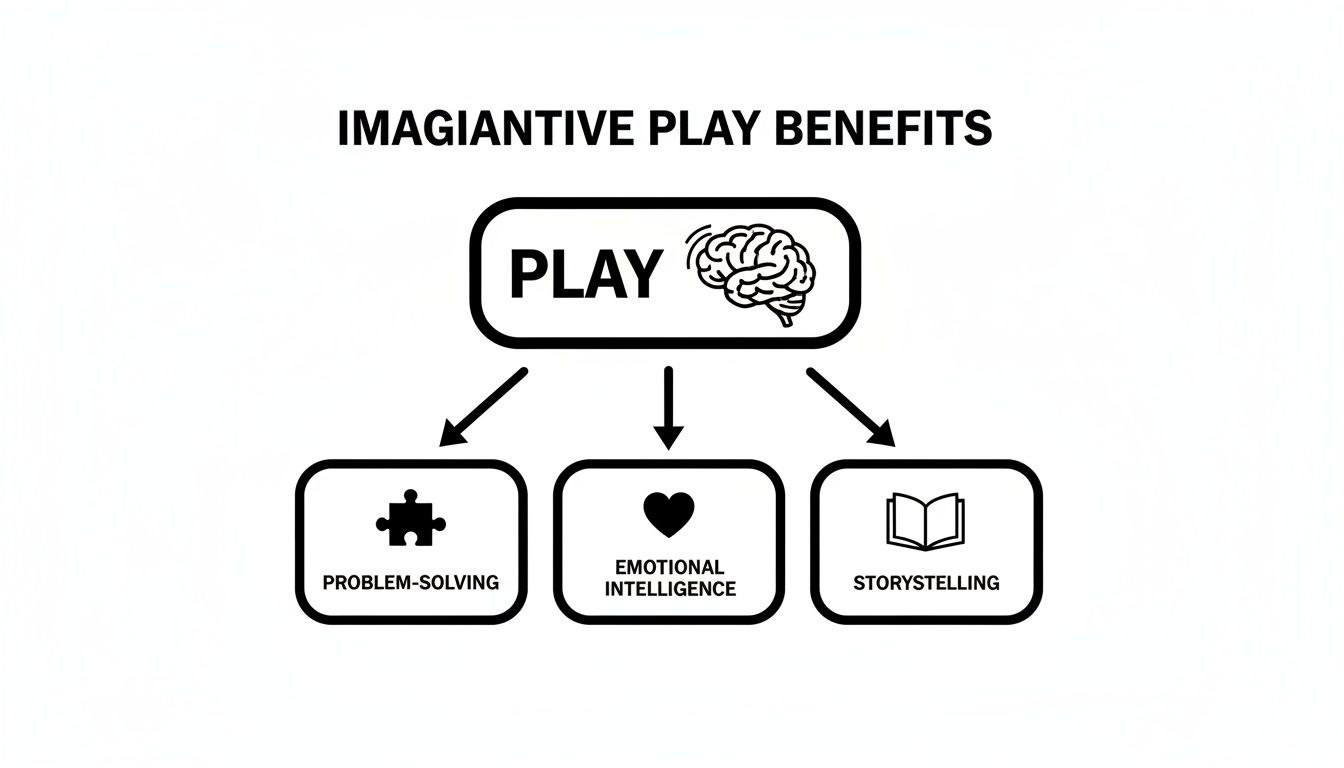
As you can see, pretend play is a direct pathway to building stronger problem-solving abilities, emotional intelligence, and storytelling skills.
School-Aged Kids (Ages 6 to 8): The Strategic Storytellers
As kids head into elementary school, their imaginative play gets more strategic and complex. They start weaving detailed plots, rules, and problem-solving challenges into their games. Their play might involve setting up a store with prices and making change, or designing a vehicle that has to complete a specific mission.
This is the perfect time to introduce toys that blend creativity with a bit of logic and strategy, pushing them to think in new ways.
A truly great toy is a prop, not a script. It gives a child the tools to build their own stories, solve their own problems, and explore worlds that exist only in their mind. This approach is vital for building a child’s ability to think independently.
This shift toward more educational play is also reflected in what parents are buying. The global educational toys market was valued at $66.22 billion and is projected to nearly double, showing just how much we value play that builds real-world skills. You can discover more insights about the educational toy market on Fortune Business Insights.
Ultimately, choosing versatile toys that can adapt to these changing stages ensures your investment lasts for years. When you focus on your child’s developmental milestones instead of just the age on the box, you provide tools that will challenge and engage them as their amazing creative abilities flourish.
What Makes a Great Imaginative Play Toy
Ever wonder what the secret is to a toy that inspires endless adventures instead of just collecting dust in a corner? When you walk down a toy aisle, it’s easy to get overwhelmed by all the flashing lights and electronic sounds. But the real key to a toy that a child will love for years isn’t how complex it is—it's actually the opposite.
The very best imaginative play toys work on a simple idea: they are a blank canvas for your child's mind. They’re an invitation for your child to become the director, the storyteller, and the hero of their own world. A great way to think about it is the 90% child and 10% toy rule. The toy is just the spark; your child's imagination should be doing all the heavy lifting.
The Power of Open-Ended Design
If there's one single quality to look for in a great imaginative toy, it's that it must be open-ended. This just means there’s no "right" way to play with it. It doesn't come with a script, a specific goal, or a single path to follow.
Think about the difference between a paint-by-numbers kit and a blank canvas with some paints. The first gives you one predetermined path to a finished picture. The blank canvas, on the other hand, is bursting with infinite possibilities. It asks, “What will you create?” instead of just saying, “Follow my instructions.”
This is exactly how the best toys work. A simple set of wooden blocks can be a castle today, a spaceship tomorrow, and a bridge for toy cars the day after that. Its potential is only limited by your child’s creativity, which makes it a fantastic tool for self-directed play.
A truly great toy is a prop, not a script. It gives a child the tools to build their own stories, solve their own problems, and explore worlds that exist only in their mind. This is how kids learn to think for themselves.
Durability and Safety Are Non-Negotiable
For a toy to be a trusted sidekick on countless adventures, it has to be able to survive them. Durability isn’t just about getting your money's worth; it’s about a toy that can grow with your child through years of enthusiastic play—being dropped, stacked, and reimagined without falling apart.
Look for toys made from high-quality, tough materials. Solid wood, sturdy fabrics, and high-grade, BPA-free plastics are usually great bets. You can often get a good sense of a toy’s quality just by holding it. Tapping a wooden block or feeling the heft of a well-made figurine can tell you a lot about how it’s made.
Of course, safety is just as crucial. Always check the age recommendations and keep an eye out for potential hazards.
- Non-Toxic Materials: Make sure any paints or finishes are certified as non-toxic and child-safe.
- No Small Parts: For younger kids, steer clear of toys with small, detachable pieces that could be a choking hazard.
- Smooth Edges: Run your hand over the toy. Check for any sharp points or rough edges that could cause a scrape or cut.
A toy that is both safe and durable gives you peace of mind and gives your child the freedom to play without limits.
The Underrated Engagement Factor
Finally, think about a toy's engagement factor. This has nothing to do with how many buttons it has, but everything to do with how well it pulls a child into a world of play. You'll often find that the most engaging toys are the simplest ones—the ones without batteries, sounds, or a list of instructions.
When a toy is passive, the child has to be active. They provide the sound effects, the dialogue, and the action. This active participation is what builds focus, creativity, and confidence. A simple toy kitchen, for instance, requires a child to imagine the sizzle of a pan or the ding of an oven. That’s a much more creative process than just pressing a button that makes the sound for them.
Choosing the right toys is all about looking past the flashy packaging. If you’re trying to find presents that hit these marks, browsing an ultimate learning gift guide for skill-building toys can give you some fantastic ideas. By focusing on open-ended design, safety, and genuine engagement, you can find toys that will truly fuel your child's imagination for years to come.
Building a World of Wonder with Core Toy Categories
Creating a toy collection that really sparks a child's imagination isn't about having one of everything. It's more like stocking a pantry with versatile ingredients. With a few key categories in place, you give your child everything they need to cook up endless creative adventures.
By focusing on these foundational types of toys, you can build a playroom that’s not just full, but functional. It helps you tune out the marketing noise and choose tools that actually work together, ready to support whatever story your child dreams up next.
These categories aren't about specific brands or the latest fads; they're about the kind of play they encourage. Think of them as the stage, the actors, and the tiny worlds that form the backbone of a creative childhood. Let's dig into the essentials.
Building and Construction Toys
This is where your child gets to be an architect, an engineer, and a city planner, all before snack time. Building and construction toys are the ultimate hands-on tools for learning about physics without even realizing it. They teach gravity, balance, and spatial awareness in the most intuitive way possible.
Whether it’s a simple tower of wooden blocks or a complex city made of magnetic tiles, these toys challenge kids to turn a pile of loose parts into something whole. The process itself is a workout for fine motor skills, patience, and the amazing ability to see a 3D structure in their mind’s eye.
Construction toys are a non-negotiable cornerstone for any creative playroom because they are, by their very nature, completely open-ended. A block is never just a block; it’s a castle wall, a spaceship, a sandwich, or a magic wand. This incredible versatility means they stay relevant for years, growing right alongside your child's imagination.
The numbers back this up, too. The global toy market recently saw sales jump by 7% in the first half of the year, and building sets were a massive driver of that growth, climbing by 12%. It’s clear these classic, hands-on toys continue to be a family favorite. You can learn more about the latest toy market trends on Circana.com.
Role-Playing and Dress-Up Props
If construction toys build the set, then role-playing props are what bring the characters to life. This entire category is about trying on different identities, which is a surprisingly powerful way for kids to develop empathy and understand the world around them.
When a child throws on a cape to become a hero or uses a toy stethoscope on a teddy bear, they’re experimenting with social roles, complex emotions, and big responsibilities. These props aren't just toys; they’re catalysts for storytelling and social problem-solving.
The best dress-up collections are often the simplest. A few key items—a hat, a shiny piece of fabric, a tool belt—can unlock dozens of characters and adventures without needing a full, pre-made costume.
This kind of play creates a safe space for kids to process their experiences and make sense of their world.
- Practicing Social Skills: Playing "restaurant" or "family" forces kids to communicate, negotiate, and work through the little disagreements that pop up.
- Exploring Emotions: Acting out scenarios gives children a chance to explore feelings like bravery, kindness, or frustration in a low-stakes way.
- Understanding Community Roles: Props like a play kitchen or a doctor's kit help demystify the adult world and the jobs people do.
Small World Play Sets
Small world play is where your child gets to be the all-powerful director of their own tiny universe. Using little figurines, toy cars, and miniature props, they create and control entire environments, from a chaotic dinosaur island to a peaceful family farm.
This type of play is a masterclass in executive function. It requires kids to plan a scene, organize their characters, and develop a story with a beginning, middle, and end. They are the set designer, scriptwriter, and lead actor all rolled into one.
These miniature worlds are fantastic for children who might prefer quieter or more independent imaginative play. It lets them explore huge ideas on a small, manageable scale, giving them a real sense of control and mastery over the stories they weave.
Together, these three categories create a powerful ecosystem for play. Building toys create the stage, dress-up props define the characters, and small world sets provide the pocket-sized universes for stories to unfold. By making sure you have a little something from each category, you’re offering a rich, balanced diet of play that nourishes every part of your child’s creative mind.
Sparking Imagination Beyond the Toy Box

While a thoughtful collection of toys is a wonderful thing, some of the best props for imaginative play aren't on a store shelf. They're probably already in your house or backyard right now.
When we show kids how to use everyday objects and bits of nature, we teach them a powerful lesson: creativity isn't something you buy, it's something you make. This simple shift in perspective turns the mundane into the magical. A plain cardboard box becomes a spaceship, a laundry basket a hot air balloon, and a pile of pillows a dragon-proof castle.
Your Home Is a Treasure Chest
Your house is already filled with raw materials for adventure. When you start seeing everyday items as "loose parts" for play, you unlock a universe of possibilities that no toy store can match. It’s a fantastic way to build problem-solving skills, and it costs absolutely nothing.
Here are a few classic examples to get you started:
- The Cardboard Box: The undisputed king of imaginative play. It can be a house, a race car, a robot costume, or a secret tunnel to another world. Give a kid some markers and a box, and the potential is truly endless.
- Blankets and Pillows: These are the essential building blocks for forts, caves, and cozy nests. This kind of hands-on construction is amazing for fostering teamwork and spatial awareness.
- Kitchen Utensils: A few pots, pans, and wooden spoons can easily become a drum kit for a rock star or the lab equipment for a master potion-maker.
The greatest gift we can give our kids is the understanding that their own imagination—not their possessions—is their most powerful tool. Wonder is everywhere, if you just know how to look.
Nature Is the Original Open-Ended Toy
Long before there were toy catalogs, kids played with what they found outside. Nature is the ultimate sensory playground, filled with the original open-ended toys that come in every texture, shape, and size imaginable.
A simple walk in the park or a hunt in your own backyard can turn up a real treasure trove of play materials.
- Sticks: A stick can be a magic wand, a fishing rod, a knight's sword, or the frame for a fairy house.
- Stones: Smooth stones are perfect for painting and turning into pet rocks or ladybugs. They can also be currency in a make-believe store or arranged into beautiful mosaics.
- Leaves and Petals: Mix them with a little water for magical "soups" and "potions," use them as plates for a teddy bear picnic, or press them to create beautiful art.
Connecting with the natural world is a calming, sensory-rich experience that beautifully balances out indoor play. When you encourage a child to find magic in a fallen leaf or a cool stone, you're nurturing a lifelong sense of curiosity. It turns out the best imaginative "toys" are often the ones that cost nothing at all.
Your Imaginative Play Questions, Answered
As a parent, stepping into the world of creative play can feel like navigating a maze. We all want to give our kids the best tools for learning and growth, but the sheer number of options and conflicting advice out there is enough to make anyone’s head spin.
This section is here to clear the air. I'll give you some straightforward, practical answers to the questions I hear most often, helping you feel more confident in fostering your child's incredible imagination. We'll cover everything from toy clutter to screen time, so let's dive in.
How Many Toys Does My Child Really Need?
It’s a classic parenting trap: believing that a mountain of toys equals a mountain of fun. In reality, the opposite is usually true. A playroom bursting at the seams can be overwhelming for a little mind. Faced with too many choices, kids often get overstimulated, flitting from one thing to the next without ever sinking into that deep, meaningful play we’re hoping for.
Think of it like being a chef. A few high-quality, versatile ingredients will spark your culinary creativity. But a kitchen cluttered with a hundred single-use gadgets? That just leads to decision fatigue. It’s the same with toys. Less is almost always more.
One study actually watched kids in a playroom and found something fascinating: those with fewer toys played more creatively and for longer with each item. They dreamed up more uses for a single toy and stayed focused. That’s a powerful takeaway for us.
Think "Quality Over Quantity"
Instead of piling up toys, aim for a thoughtfully curated collection. A good set of versatile blocks, a few dress-up items, and a handful of animal figures can provide far more creative fuel than a dozen electronic toys that only do one thing.
This approach doesn't just cut down on clutter—it actively encourages your child to become a more resourceful and inventive thinker.
Are Electronic Toys Bad for Imagination?
This is the big one, isn't it? The short answer is no, electronic toys aren't automatically "bad." Their impact really hinges on how they're designed. The most important question you can ask is this: Does this toy do the thinking for my child, or does it invite my child to do the thinking?
A toy that talks, sings, and barks orders turns a child into a passive follower. It's like watching a movie versus writing the script. The child just pushes buttons and follows prompts, leaving very little room for their own ideas to blossom. Their creative muscles aren't getting a workout because the toy is doing all the heavy lifting.
But not all tech is a creativity killer. Some digital tools can be amazing springboards for the imagination.
- Creative Tools: A simple stop-motion animation app on a tablet can help a child bring their wild, elaborate stories to life.
- Open-Ended Games: Digital building games are a fantastic complement to physical blocks, offering new ways to explore architecture and design.
- Problem-Solving Tech: Toys that introduce the basics of coding encourage kids to think logically and creatively to solve a puzzle.
The trick is to see technology as just another tool in the play chest. The best electronic toys act like a blank canvas, not a paint-by-numbers kit.
What Is the Best Way to Encourage More Imaginative Play?
If you notice your child isn't diving into pretend play as much as you'd like, don't sweat it. Every kid is different, and sometimes they just need a gentle nudge or a more inviting setup. The best strategies are usually the simplest ones. It's all about creating the space for creativity and modeling the joy of make-believe yourself.
One of the most powerful things you can do is create an "invitation to play." This is where you set up a simple, intriguing scene and then walk away, leaving it for them to discover.
Example Invitation to Play
- The Scene: Drape a blue silk scarf on the floor to look like a river. Place a few animal figures on one side and a small pile of wooden blocks on the other.
- The Result: You’ve just created a story starter. Is it a rescue mission? A bridge-building challenge? A journey to a new land? Your child gets to decide.
This hands-off approach honors their autonomy while sparking their natural curiosity.
How to Get Involved Without Taking Over
Jumping into your child’s game is one of the best ways to connect and encourage them, but it’s a delicate dance. There's a fine line between participating and directing. When you step into their world, your goal is to be a supporting actor, never the director.
Your job is to follow their lead, period. If they hand you a block and say it's a phone, you answer it. If they declare the floor is hot lava, you hop onto the couch. When you accept their reality, you validate their ideas and give them the confidence to build their stories even bigger.
Here are a few tips to be a great play partner:
- Ask Open-Ended Questions: Instead of saying, "Let's build a tower," try, "I wonder what we could build with these?" This puts the creative power right back in their hands.
- Be a Playful Assistant: Let them give you a role and a job. Just listen to their instructions and respond within the world they’ve created.
- Model Curiosity: Wonder out loud. "Oh no, the baby doll looks hungry! What should we make for her?" This shows them how to solve problems within the game.
Ultimately, fostering imaginative play is less about buying the best imaginative play toys and more about creating an environment where curiosity can thrive. By focusing on versatile toys, setting thoughtful boundaries with technology, and joining in with genuine wonder, you're giving your child the perfect foundation for a lifetime of creative thinking.
At Learning Through Play, we believe in the power of simple, effective tools that empower children to become the heroes of their own stories. Explore our curated selections to find the perfect props for your child's next great adventure. Learn more about our philosophy and products at https://admin.shopify.com/store/learningthoughtplay.