
It’s easy to look at a child’s trouble with focusing and their struggles with reading as two separate things. But the truth is, ADHD and dyslexia frequently occur together. For many kids, it feels like trying to read a book in a noisy, distracting room—one challenge makes the other one so much harder. This reality creates a unique set of difficulties that need a truly integrated approach to support.
Untangling the ADHD and Dyslexia Connection

When a child is struggling in school, our first instinct is to find a single, simple reason. Is it an attention problem, or is it a reading problem? The answer is often more complex: it can absolutely be both.
While ADHD (Attention-Deficit/Hyperactivity Disorder) and dyslexia are two distinct neurodevelopmental conditions, they share a significant and often confusing overlap.
Pinning all of a child's difficulties on just one condition can lead to partial support and a whole lot of frustration. For example, a child might get a fantastic reading tutor but still be unable to organize their thoughts for a book report because of underlying ADHD. On the flip side, they might get help with focus, only to find that reading is still exhausting due to undiagnosed dyslexia. Getting this connection right is the first and most important step toward providing help that actually works.
Why Do ADHD and Dyslexia Overlap So Often?
This high rate of co-occurrence is no accident. It points to shared, underlying difficulties in the brain's executive functions—the command center skills that manage things like working memory, mental flexibility, and self-control. Both conditions can affect how the brain processes information, sequences tasks, and sustains focus.
The link is well-established. Research consistently shows that about 30–50% of children with ADHD also have a learning disability like dyslexia. Likewise, it's estimated that around 30% of people with dyslexia also have ADHD, with some studies suggesting the numbers could be even higher.
What looks like a simple reading problem might be amplified by an attention issue. And what looks like carelessness might actually be a brain-based challenge with processing sounds in words. Seeing this dual reality is the key to unlocking real progress.
Moving From Confusion to Clarity
Once you acknowledge that both ADHD and dyslexia could be at play, you open the door to a more accurate diagnosis and a support plan that’s actually built for your child. Instead of trying to fix separate problems, you can finally see the whole picture of their unique brain wiring.
This guide will help you find a clear path forward by helping you:
- Recognize the unique and overlapping signs of each condition.
- Understand the process for a thorough evaluation that looks for both.
- Discover practical, evidence-based strategies for home and school.
To get a better grasp of how these conditions relate to academic performance, it's helpful to explore the connection between ADHD and learning disabilities. This knowledge is power—it helps you become a stronger advocate, ensuring your child gets the well-rounded support they truly need to succeed.
What Is ADHD and What Is Dyslexia?
To really get a handle on the connection between ADHD and dyslexia, we first have to clear away the stereotypes and look at each condition on its own. They're not the same thing at all, and understanding them separately is the key to seeing why their paths so often cross.
Let's start by laying a solid foundation for what's actually happening in the brain.
Defining ADHD: The Brain's Air Traffic Control System
Attention-Deficit/Hyperactivity Disorder, or ADHD, is widely misunderstood. People often think it's just about being "hyper" or unable to pay attention, but the reality is much more complex. At its core, ADHD is a neurodevelopmental condition that impacts the brain's executive functions.
Think of your brain's executive functions as the air traffic control tower for your mind. This system has the massive job of managing all the information coming in and going out. It's what helps you:
- Prioritize tasks (deciding which plane gets to land first).
- Maintain focus (tracking one plane without getting distracted by all the others in the sky).
- Manage impulses (stopping a plane from taking off without clearance).
- Regulate emotions (keeping the control tower calm and running smoothly, even under pressure).
For someone with ADHD, this air traffic control system doesn't always run smoothly. It can be inconsistent—sometimes it works perfectly, but other times it struggles to keep up. This leads to very real challenges with organization, managing time, and keeping emotions in check. It's not a lack of willpower; it’s simply a difference in how the brain’s management system is wired.
A key thing to remember is that ADHD isn't about an inability to focus. It's about an inability to regulate focus. Many people with ADHD can "hyperfocus" for hours on things they find genuinely fascinating, yet struggle to stay tuned in for even a few minutes on tasks they find boring.
This internal inconsistency can make school, work, and daily routines feel chaotic. A child with ADHD, for example, might completely understand their homework assignment but find it nearly impossible to start. The "prioritization" and "initiation" signals from their control tower just aren't coming through loud and clear.
Defining Dyslexia: The Brain's Sound-Processing Center
Dyslexia, on the other hand, is a specific learning disability that's all about language processing. The biggest myth out there is that dyslexia is about seeing letters backward—it's not. The real issue lies with phonological processing, which is the brain's ability to hear, identify, and play with the individual sounds inside of words.
Picture a sound-processing center in your brain. Its main job is to create strong links between the sounds of language (phonemes) and the letters or letter combinations that represent them (graphemes). This skill is the absolute bedrock of learning to read.
For a person with dyslexia, that sound-to-letter connection is weak or less automatic. Their brain might have a tough time with things like:
- Decoding new words: Sounding out a simple word like "c-a-t" can be a slow, mentally draining process.
- Recognizing rhymes: It might be genuinely hard to notice that "boat" and "coat" share a sound.
- Memorizing sight words: Words that can't be sounded out are incredibly difficult to lock into memory.
This makes reading slow, exhausting, and often deeply frustrating. It has absolutely nothing to do with intelligence; it's a specific breakdown in the brain's language machinery. Dyslexia is one of the most common neurodevelopmental differences, with many experts estimating it affects around 10% of the population. That means hundreds of millions of people worldwide are navigating this challenge. You can find more insights about dyslexia's global prevalence on the National Center for Biotechnology Information's website.
Once we understand ADHD as a challenge with the brain's management system and dyslexia as a challenge with its language-sound system, it becomes much clearer why having both creates such a unique and significant hurdle.
Spotting the Signs: Similarities and Key Differences
Trying to figure out if a child’s struggles come from ADHD, dyslexia, or both can feel like genuine detective work. The clues often look the same on the surface—messy backpacks, unfinished homework, and a general reluctance toward schoolwork are common to both.
The real key is understanding the why behind the behavior. A child with dyslexia might avoid a book because the very act of decoding the words on the page is mentally exhausting. On the other hand, a child with ADHD might avoid that same book because sitting still and maintaining focus feels like an impossible task. Untangling these different motivations is the first real step toward getting a clear picture.
This diagram helps visualize how the brain’s wiring differs in these two conditions.
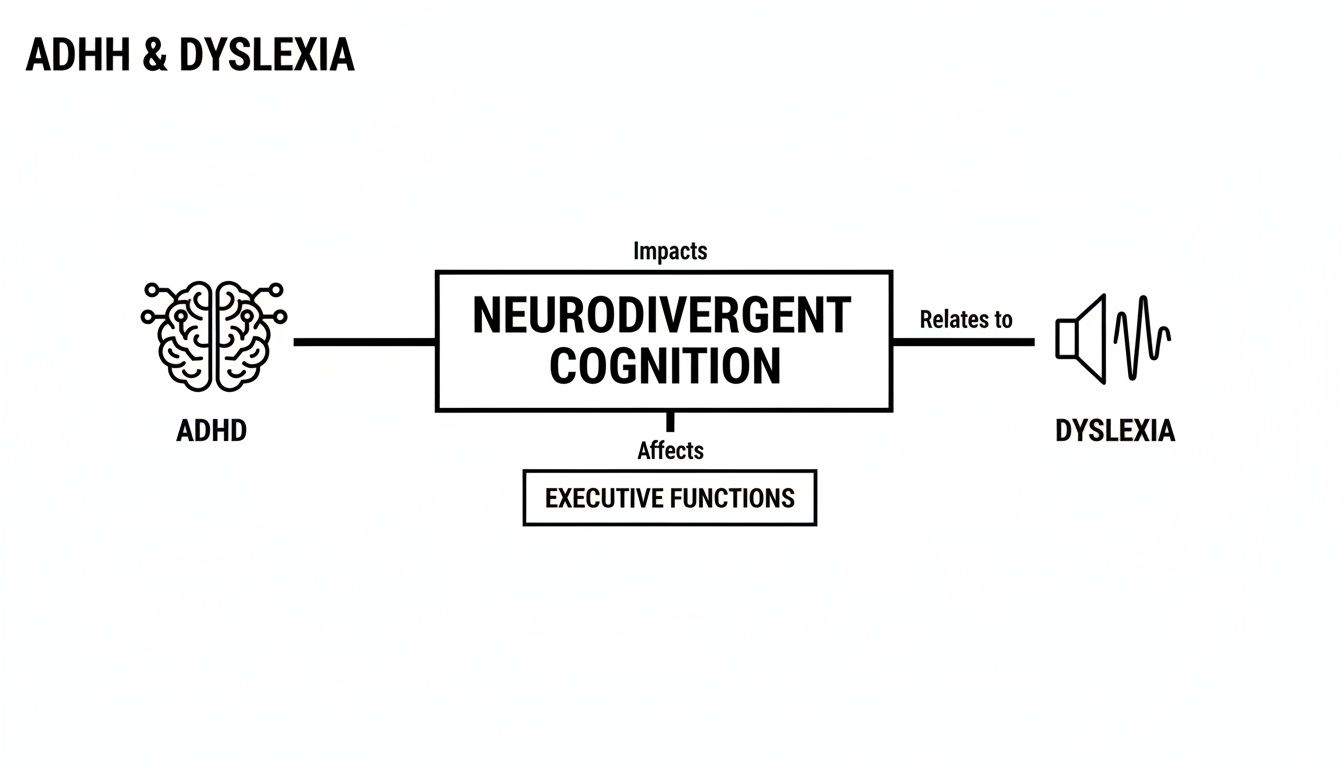
It frames ADHD as a challenge with the brain’s executive management system, while dyslexia is primarily a difficulty with the phonological, or sound-based, processing of language.
Overlapping Traits in Daily Life
The confusion between ADHD and dyslexia is completely understandable, as they share a lot of common ground. Both can throw a wrench into a child's executive functions—the mental skills we all use to plan, organize, and get things done.
You’ll often see this overlap show up in three key areas:
- Working Memory: Think of this as the brain's "sticky note" for holding information temporarily. A child might struggle to recall multi-step instructions, but is it because a dyslexic brain is overloaded by the language, or because an ADHD brain got distracted mid-sentence? It can be tough to tell.
- Processing Speed: This is all about how quickly someone can take in information, make sense of it, and then respond. Both conditions can slow this down, making it hard to keep up in class or finish timed tests.
- Organizational Difficulties: The classic signs—messy desks, lost permission slips, and forgotten due dates—are hallmarks of both. This disorganization often comes from underlying trouble with sequencing, prioritizing, and managing time.
Because these signs are so similar, it’s easy to misattribute the cause. A teacher might see messy handwriting and assume the child is rushing (ADHD), when it could actually be linked to the fine motor challenges that sometimes go hand-in-hand with dyslexia.
Key Distinctions in Reading and Writing
While the daily life challenges can look alike, the differences become much clearer when you zero in on reading and writing. This is where the core nature of each condition really reveals itself.
A child dealing primarily with dyslexia will show specific struggles with the mechanics of language. You might see:
- Trouble sounding out new, unfamiliar words.
- Reading that sounds slow, choppy, and full of effort.
- Spelling mistakes that are often phonetic, like writing "fone" for "phone."
- Difficulty with rhyming games or picking out individual sounds in words.
In contrast, a child with primarily ADHD might read the words just fine but struggles with the process of reading. Their challenges often look more like this:
- Skipping words, lines, or even whole paragraphs.
- Losing their place on the page constantly.
- Forgetting what they just read, leading to poor reading comprehension.
- Getting easily pulled off-task by noises or movements in the room.
A great way to frame it is that dyslexia creates a barrier to decoding the text, while ADHD creates a barrier to attending to the text. When a child has both, they have to navigate both of those hurdles at the same time.
Comparing Symptoms of ADHD and Dyslexia
To make these distinctions even clearer, it helps to see the common symptoms laid out side-by-side. The table below breaks down how these challenges can appear differently in academic and daily tasks, helping you spot the patterns more effectively.
| Symptom Area | Primarily Dyslexia | Primarily ADHD | Potential Overlap |
|---|---|---|---|
| Reading Fluency | Reading is slow, choppy, and full of hesitations due to decoding issues. | Reading speed may be inconsistent; may read too fast and make careless errors. | General reading avoidance and fatigue from the mental effort required. |
| Spelling | Errors are often phonetic and inconsistent (e.g., spelling the same word differently). | Errors are often due to inattention, such as leaving out letters or words. | Messy handwriting and disorganized written work. |
| Following Directions | Struggles with written instructions due to reading difficulty. | Struggles with multi-step verbal instructions due to poor working memory or distraction. | Difficulty completing tasks that require sustained mental effort. |
| Homework Avoidance | Avoids tasks that require heavy reading or writing because they are exhausting. | Avoids tasks because they are boring, long, or require sustained focus. | Procrastination on assignments and a feeling of being overwhelmed. |
Understanding these nuances is more than just an academic exercise. It empowers you to give clear, accurate observations to teachers and specialists, which is a critical part of the journey toward getting the right diagnosis and, most importantly, the right support.
The Path to a Comprehensive Diagnosis
Figuring out if you or your child has both ADHD and dyslexia can feel like trying to solve a puzzle with a thousand tiny pieces. It’s a winding road, and it’s completely normal to feel a bit lost at first. But a proper evaluation isn’t a one-and-done appointment; it's a careful process that brings together different experts to see the whole picture.
Think of it like a detective story. A single clue rarely solves the case. To get to the truth, you need multiple sources of information. A quick diagnosis often misses the mark because it fails to see how attention challenges and language processing struggles can overlap and influence each other. That’s why a team approach is non-negotiable.
Assembling Your Diagnostic Team
The best evaluations bring together a team of professionals who can look at the situation from all angles. This collaboration is key to making sure one condition isn’t hiding or being mistaken for the other.
Your team will usually include a few key players:
- Pediatrician or Developmental Pediatrician: This is often your first port of call. They can check for other medical factors, like vision or hearing issues that might be muddying the waters, and refer you to the right specialists.
- Educational Psychologist or Neuropsychologist: These are the real investigators. They use specialized cognitive and academic tests to map out specific areas of strength and challenge, getting to the heart of how someone’s brain works.
- School Professionals: Don't underestimate the power of on-the-ground insights. Teachers, special education staff, and school counselors see firsthand how a child functions in the classroom, both academically and socially.
Working together, this team pieces together a complete picture, showing not just what the challenges are, but why they’re happening.
What to Expect During the Evaluation
A truly thorough evaluation for both ADHD and dyslexia is anything but simple. It’s a deep dive that goes way beyond checklists or a quick chat. The goal is to collect information from many different sources to build a full profile of a person's learning and behavior.
An accurate diagnosis requires looking at the whole person, not just a list of symptoms. The process should uncover how a person's brain is wired for both learning and attention, leading to a truly personalized support plan.
Here’s a breakdown of what the process usually involves:
- Clinical Interviews: The specialists will sit down with you and your child to talk through everything—developmental history, school experiences, behavioral patterns, and family background.
- Cognitive Assessments: These tests measure core brain functions like working memory, processing speed, and reasoning skills. They help identify the underlying cognitive machinery at play.
- Academic Skills Evaluation: This is where the rubber meets the road for reading, writing, and spelling. The testing specifically looks for the tell-tale signs of dyslexia, like difficulties with phonological awareness (connecting sounds to letters).
- Behavioral Rating Scales: You, your child’s teachers, and sometimes your child will fill out detailed questionnaires. These forms help measure and quantify behaviors tied to inattention, hyperactivity, and impulsivity in different settings.
Preparing for a Successful Assessment
Your role in all of this is huge. As a parent or advocate, you have a perspective that no one else does. Coming prepared can make a massive difference in getting an accurate outcome.
Start by gathering key documents—report cards, notes from teachers, and any previous evaluations. It’s also incredibly helpful to keep a simple log of your own observations. When do the struggles pop up? What do they actually look like? Jotting these things down provides concrete examples. And finally, come with a list of questions. This helps ensure your biggest concerns get the attention they deserve.
Unfortunately, many people, especially adults, never get this kind of comprehensive look. While an estimated 40 million adults in the U.S. may have dyslexia, some reports suggest only about 2 million have ever been formally diagnosed. This is a massive gap, leaving countless individuals without the understanding or support they need. You can learn more about this diagnostic gap from insights on the Yellowbus ABA blog. By pushing for a thorough diagnosis, you’re taking a powerful step toward getting the right tools for success.
Practical Strategies for Home and School Success

Knowing the connection between ADHD and dyslexia is one thing, but putting that knowledge into action is where you'll see real, meaningful change. The key is to create a seamless support system that bridges the gap between home and school, helping your child feel capable and understood.
This means building a practical playbook of strategies that tackle both the attention struggles of ADHD and the language-based challenges of dyslexia. The goal isn't just to help them get by; it's to reduce their cognitive load, lean into their unique strengths, and establish routines that actually support their developing brain.
Powerful Accommodations for the Classroom
A supportive school is non-negotiable. For a child juggling both ADHD and dyslexia, a formal plan like an Individualized Education Program (IEP) or a 504 Plan is the official key to unlocking the right support. These adjustments aren't about giving an unfair advantage—they're about leveling the playing field.
Think of it this way: you wouldn't ask someone who needs glasses to take a vision test without them. Classroom accommodations are the educational equivalent, allowing a child’s true intelligence to shine through.
Here are some of the most effective school-based supports:
- Assistive Technology: This is a game-changer. Text-to-speech (TTS) software reads digital text aloud, which can be a lifeline for a child exhausted by decoding. On the flip side, speech-to-text (STT) tools let them dictate essays and answers, bypassing the mechanics of writing to get their brilliant ideas down on paper.
- Audiobooks: Giving a student audio versions of class novels ensures they keep up with the story and can participate in discussions. It separates the act of reading from the joy of literature.
- Extended Time: Both ADHD and dyslexia can slow things down. Extra time on tests isn't about giving more time to cheat; it's about giving the brain the space it needs to process a question and formulate a thoughtful answer.
- Modified Assignments: This could look like fewer math problems (while still covering the same concepts) or getting a copy of the teacher’s notes beforehand. The focus should always be on assessing what the child knows, not their stamina.
- Preferential Seating: It sounds simple, but seating a child near the teacher and away from the chaos of the door or pencil sharpener can dramatically reduce distractions. It’s a small change with a huge impact.
True accommodation is about removing barriers to learning, not lowering academic expectations. The right supports empower students with ADHD and dyslexia to demonstrate what they truly know and can do.
Building Supportive Routines at Home
Home should be a safe harbor where kids can build skills and confidence without the pressure of the classroom. Your most powerful tool here is consistency. For a brain that struggles with focus and organization, predictable routines create an anchor of calm in a chaotic world.
A structured home life doesn't mean being rigid or joyless. It simply provides an external framework that helps a child organize their internal world, making everyday tasks feel much less daunting.
Making Homework Manageable
The nightly homework battle is a classic struggle for families navigating this dual diagnosis. The secret is to reframe it from a dreaded chore into a more manageable, and even engaging, activity.
Here are a few tips to get you started:
- Create a "Launch Pad": Designate a single, clutter-free spot just for homework. Make sure all the supplies—pencils, paper, chargers—are already there. This tackles the first big hurdle of executive function: simply getting started.
- Break It Down: A massive worksheet can feel completely overwhelming. Slice assignments into small, bite-sized chunks with short, active breaks in between. Try using a timer for 15-minute "work sprints" followed by a 5-minute break to stretch or grab a snack.
- Go Multisensory: Learning doesn't just happen with the eyes. Use magnetic letters to spell words, trace letters in a tray of sand, or use colored highlighters for different parts of a math problem. This helps information "stick" in a way that just looking at a page can't.
- Embrace Gamification: A little fun goes a long way. Turn studying into a game with flashcard apps, educational websites that award points, or a simple bingo card of tasks to complete. Motivation skyrockets when it doesn't feel like work.
For any child with ADHD, wrestling with focus is part of the territory. Exploring proven ways to help children improve focus can make these home strategies even more effective. When you blend structure with fun, you don't just get the homework done—you empower your child and strengthen your bond.
Building a Future of Confidence and Success
When you're dealing with the day-to-day realities of ADHD and dyslexia, it's easy to get caught up in the challenges. But that's only part of the picture. It's time to reframe how we look at these conditions—not as deficits, but as fundamentally different ways of seeing and interacting with the world.
These differences often come with some truly remarkable gifts. Think about it: the very wiring that can make schoolwork tough is often the same wiring that fuels incredible, out-of-the-box creativity. It's what builds deep resilience from years of navigating a world not built for them. It’s the ability to grasp the big picture while everyone else is still stuck on the details.
In fact, you'll find that many of the most successful entrepreneurs, artists, and innovators will tell you their neurodivergent minds are behind their greatest achievements.
Seeing Strengths, Not Just Struggles
The real takeaway here is simple: with the right understanding, personalized strategies, and unwavering support, children with ADHD and dyslexia don't just get by—they can absolutely thrive. Your role in this is huge. You’re not just a supporter; you're the advocate who helps them see their own strengths and build on them.
This means finding and celebrating their unique talents, whether that’s a knack for visual arts, a passion for building things by hand, or a natural gift for empathetic leadership. When we change our own perspective, we give them the power to change how they see themselves.
Thriving with ADHD and dyslexia begins the moment we stop asking, "What's wrong?" and start asking, "What are you amazing at?" This shift—from fixing weaknesses to building on strengths—is the true foundation of confidence.
A Message of Hope and Empowerment
It’s worth remembering that countless inspiring people have both conditions and have gone on to build extraordinary lives. Think of the business leaders who spot market trends no one else sees, or the designers whose spatial reasoning is completely off the charts. Their stories aren't just feel-good anecdotes; they're powerful proof that a different kind of brain can be a powerful kind of brain.
Your advocacy and your belief in your child’s potential are the most important tools you have. By creating the right support system and focusing on their inherent gifts, you’re helping them build a future defined not by their challenges, but by their confidence, their resilience, and their own unique brand of success.
Your Questions, Answered
When you're trying to understand ADHD and dyslexia, it's natural to have a lot of questions. Let's walk through some of the most common ones that parents and educators ask, so you can find the clarity you need to take the next step.
Can a Child Just Outgrow ADHD or Dyslexia?
That’s a common hope, but the short answer is no. Both ADHD and dyslexia are lifelong neurotypes, meaning they're tied to how an individual's brain is wired. They aren't something a child simply grows out of like a pair of shoes.
But that’s not the whole story. While the underlying neurology doesn't change, the way a person experiences these conditions absolutely does. With the right support, strategies, and understanding, individuals can learn to manage their challenges incredibly well. Many adults find ways to not only cope but to turn their unique ways of thinking into major strengths in their careers and personal lives.
The goal isn't to "fix" or "cure" anything. It's about giving them the tools and building the skills to thrive with their brain, not fight against it.
I Think My Child Might Have Both. What Should I Do First?
Feeling that hunch can be overwhelming, but the first step is clear: talk to your child's pediatrician and their school. Before you do, start jotting down what you're seeing at home—specific examples of their struggles with reading, staying focused, writing, or behavior. Your notes will be invaluable.
The pediatrician is your starting point for ruling out other potential causes, like vision or hearing issues, and can give you a referral to a specialist. This might be a developmental pediatrician or a neuropsychologist who can conduct a full evaluation. At the same time, schedule a meeting with your child's teacher and the school's support team. Share your concerns and ask them about their process for an educational assessment. Getting both medical and educational perspectives is key.
Is There Any Technology That Actually Helps?
Absolutely! The right assistive technology can be a total game-changer, taking a huge weight off a child's shoulders and making learning feel possible again. These tools are designed to work around the challenges, not through them.
Here are a few of the most helpful types:
- Text-to-Speech (TTS) Software: Imagine being able to listen to a textbook or any digital text. This tech reads words aloud, which is a lifesaver for kids who get exhausted just from decoding words. It frees up their mental energy to focus on what the text actually means.
- Speech-to-Text (STT) Tools: Also called dictation, this lets kids write by speaking. It's fantastic for getting their brilliant ideas out without getting bogged down by the mechanics of spelling and typing.
- Digital Planners and Reminder Apps: These are modern-day heroes for tackling the executive function hurdles of ADHD. They help with everything from remembering homework to breaking down big projects into smaller steps.
Many of the best tools today are designed with both conditions in mind, like apps that highlight text as it's being read aloud. This multi-sensory approach provides powerful, integrated support.
At Learning Through Play, we know that every child’s brain is unique. We're passionate about providing toys and tools that build skills, boost confidence, and celebrate every developmental journey. Explore our collections and find the perfect resource to help your child thrive.